

The saying is as old as they come. “Don’t judge a book by its cover.”
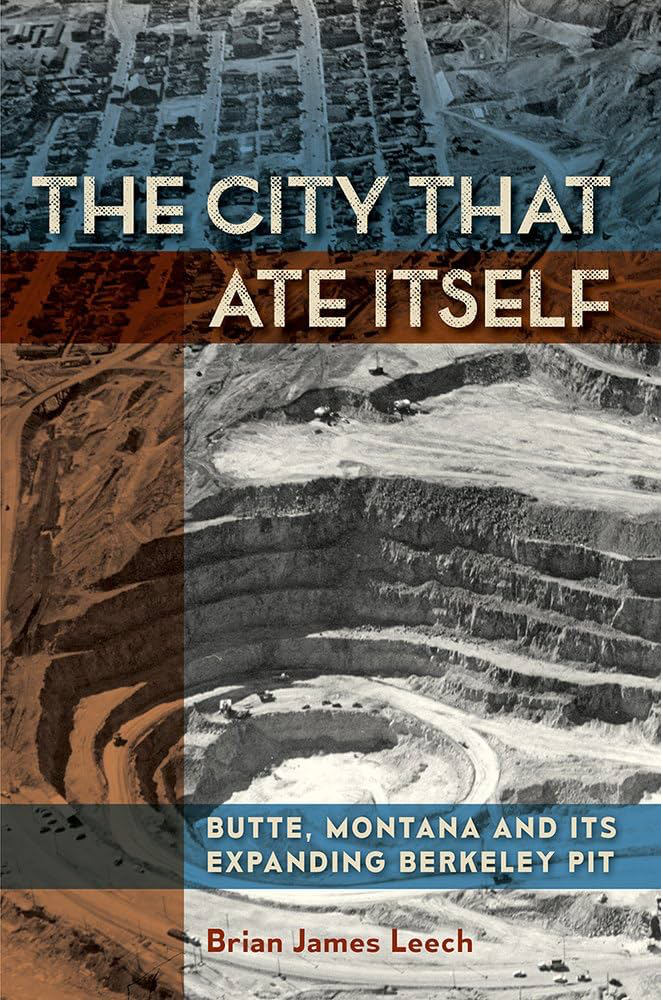
When it came to the book titled “The City That Ate Itself,” however, I did exactly that. When the book was released several years ago, I decided to pass because I did not like the cover.
Actually, I didn’t like the title. It offended my Butte sensibilities.
It reminded me of all the times someone has said to me, in a demeaning tone, “Oh, you’re from Butte?”
The book’s subtitle is “Butte, Montana and Its Expanding Berkeley Pit,” and the book was written by Brian James Leech, who is from Bozeman, of all places.
About five years after the book was released, I decided to finally give it a crack when my friend Michele Shea wholeheartedly recommended it.
She didn’t just casually suggest it. She told me I had to read it, as if she was Char Davis and I was back in sophomore English class.
Like usual, Shea was right, and boy was I ever wrong. I liked the book so much that I now even understand the title.
Really, it makes sense because the author was trying to sell his book to an audience that is much bigger than the Mining City. While the title might have seemed a bit offense — though it shouldn’t have — it will jump off the book shelf to a reader who wasn’t born and raised fighting the stigma of growing up in a mining camp.

While the title wasn’t inspiring, the author won me over early when he mentioned Harry Fritz, my favorite history professor at the University of Montana. Leech apparently liked Fritz’s Montana history class as much as I did.
Leech wrote about how the parents of his Bozeman teammates would make snide comments about Butte when his soccer teams came to town. His parents, though, told him about Butte’s storied mining history, and it apparently struck a chord.
It was nice enough to see that an outsider would look at the ugly mining scars and give us the benefit of the doubt. It was even better that one spent so long researching a book that should be required reading for every high school student in town.
Actually, it should be mandatory reading for every person who lives or has ever lived in Butte. People who look down on Butte should read it, too.
Simply put, the book is incredible. It tells the story of the Berkeley Pit overtaking and eventually swallowing up the Butte neighborhoods of the McQueen, Meaderville and East Butte.
For outsiders, it exposes of the pitfalls of living near an open-pit mine. For Butte residents, it is a memoir of the great neighborhoods that most of us only ever heard of.
Leech describes the sad tale of neighbors being separated, buildings being destroyed and communities being devastated.
Shea suggested the book because I am embroiled in a fight to save what is left of the Dublin Gulch, which was Butte’s first neighborhood, from being a dumping ground for toxic slime dug up in Superfund cleanup.
The fight is much different, but still somehow similar.
I had always heard about McQueen, Meaderville and East Butte, but I never knew much about the fight to save them until I was lucky enough to be one of the first to view the movie “Resurrecting Holy Savior” this spring.
The iconic photo taken by the great photographer Walter Hinick of a dump truck dropping its load on top of the Holy Savior Church was the inspiration for first-time filmmakers Jody Franich and Dan Fulton.
That was the first time I heard about the fights for those neighborhoods. I had just always kind of assumed that people went along with the move because, after all, what was good for the company was good for Butte.
The movie was also the first time I heard about Jimmy Shea, the combative mayor of Walkerville.
Shea is featured in Leech’s book. He was the mayor who was not afraid to stand up to the all-powerful Anaconda Company, and he was also one of the very few to register victories of any kind.
If it wasn’t for Shea’s tenacity, the Alice Pit very well might have completely swallowed up most of Walkerville.
We need more politicians like Jimmy Shea, and he has become one of my inspirations for the Dublin Gulch fight.

“The City That Ate Itself” is littered with names of people we know. It contains names like Fritz Daily, Don Peoples, Jim Michelotti, Pat Cunneen, Pauline deBarathy, Chris Fisk and Matt Vincent.
It describes the labor disputes and strikes, the Columbia Gardens and the fight over relocating Uptown Butte on the Flats.
That brought back memories of my parents talking about possibly being bought out of our home in Corktown when I was very young. I was reminded of the suspicious fires in our neighborhood — fires that conveniently helped the Company obtain land on the Butte hill.
It made me realize that growing up across the street from a mine dump and playing on the “Yellow Hill” as a kid wasn’t a normal thing, I always made it out to be.
Watching “Resurrecting Holy Savior” and reading “The City That Ate Itself” made me realize just how terrifying it must have been for the members of Butte’s lost neighborhoods in their final days.
The book describes underground mining, the movement toward open-pit mines and the flying rocks and broken windows from the Berkeley blasting.
It might even explain to outsiders why we stayed here anyway. It might make them stop looking down on us so much.
I have long been a student of Butte history. Or at least I thought I was. I read “Copper Camp” and “Mile High Mile Deep.” My favorite book about Butte was “Fire and Brimstone,” the tale of the Speculator Fire of 1917, written by Michael Punke.
“The City That Ate Itself” is right on par with “Fire and Brimstone.”
Those books tell the true story of Butte, and they capture the heart and soul of the great people of the Mining City.
They also subtly remind the rest of the world just how important our city was in the development of modern society and helping the good guys win two world wars.
No matter where you are from, I highly recommend “The City That Ate Itself.” If you are from Butte, you just have to read it.
Oh, and buy your own. I would let you borrow mine, but Leech deserves the money for his great work of journalism.
Even if you don’t like the book’s title, you won’t be able to put it down.
— Bill Foley, whose big, round head has been compared to Charlie Brown since Day 1, can be reached at foles74@gmail.com. Follow him at twitter.com/Foles74. Listen to the ButteCast on Apple Podcasts, Spotify or wherever you find your favorite podcasts.
 The ButteCast with Bill Foley
My only correction is that’s it not. Work of journalism, it’s a work of history. Leech is a professor of history.
LikeLike