
-
Leskovar Honda Athletes of the Week: Boyle’s Buddies

The Boyle’s Buddies Special Olympics basketball players are this week’s Leskovar Honda Athletes of the Week.
The honors come after they put on another stellar performance during the Boyle’s Buddies game, which is part of the Burgman/Boyle Classic. The game was played Sunday evening in honor of Kyle Burgman and Casey Boyle. The two Butte friends were killed in an automobile accident on Aug. 10, 2015.
A year after the accident, the Burgman/Boyle Classic alumni basketball game was first played on the anniversary of the tragedy in 2016. The Boyle’s Buddies game was the opening act for that contest at first. Now, it is the only remaining game of the event, which coincides with the handing out of the Burgman/Boyle Scholarships.

This year’s game was a three-one-three contest at the Knights of Columbus’ Felix Madrazo Gym. The game included Special Olympians Zach Stenson, Krystina Segna, Tristan Grogan and Josh Mota playing with Tom Boyle, Casey’s brother, and Hunter Boyle, Casey’s nephew. Kallie Robbins, who says she is retired from basketball, ran the scoreboard.
Stenson, Segna and Hunter Boyle beat Grogan, Mota and Tom Boyle 53-34. Of course, the most important part of the game for all players, however, was remembering and honoring Casey Boyle, a popular special education teacher and coach, and Kyle Burgman, a basketball star for Butte High.
Since the beginning of 2023, Leskovar Honda, home of the non-commission sales staff that always has your back, has teamed up with the ButteCast to honor the finest student-athletes from the Mining City to encourage more children to get up, get out and try all kinds of sports and activities.
-
Nine individuals set to join Central’s ‘Legends’ Hall of Fame

Butte Central Catholic High School unveiled the 2026 class of the Maroon “Legends” Hall of Fame today.
The program was created to recognize and celebrate individuals, families, coaches, and supporters who have made significant contributions to the school’s proud tradition of athletic and extracurricular excellence.
The 2026 inductees were recently selected by the Butte Central Education Foundation.
The induction ceremony will be held Friday, Sept. 11 at the Maroon Activities Center as part of Butte Central’s 2026 Homecoming celebration. Inductees will also be recognized before the Maroons’ Homecoming football game against Ronan.

Nine outstanding individuals have been selected for induction into the 2026 Maroon “Legends” Hall of Fame. They are Otto Simon, Mick Delaney, Dan Mahoney, Bernie Boyle, Tom Kenney, Julie (Leary) Nadeau, Theresa Rader, Katie English, and Shirley Turley.
Butte Central president Don Peoples Jr. said the newest Hall of Fame class represents the very best of the Maroon tradition.
“We are excited and proud to celebrate the achievements and support of these incredible Maroons,” Peoples said.
The Maroon “Legends” Hall of Fame continues to recognize those whose dedication, leadership, athletic accomplishments, coaching excellence, and service have helped build and sustain the proud tradition of Butte Central Catholic High School.
Meet the Maroon “Legends” Hall of Fame Class of 2026:

Otto Simon (Class of 1953)
The late Otto Simon was an outstanding football player for the Maroons before continuing his playing career with the University of Montana Grizzlies. He later returned to Butte Central, where he became a highly respected basketball coach and offensive line coach, helping shape generations of Maroon athletes.Mick Delaney (Class of 1961)
Mick Delaney excelled as a football player at Butte Central before embarking on an exceptional coaching career. He began coaching at Butte Central during the 1960s before moving to the collegiate ranks, serving as an assistant coach at Montana State University and Colorado State University. Delaney also served as head coach at both the University of Montana Western and the University of Montana. During the 1970s, he guided Great Falls High School to a Class AA state football championship.Dan Mahoney (Class of 1969)
Dan Mahoney was a standout football and basketball player for the Maroons. He was a member of the 1969 Butte Central basketball team that upset Wolf Point in the State Basketball Tournament. Mahoney later starred as a linebacker for the Montana Tech Orediggers and played in the 1970 Copper Bowl Game.Bernie Boyle (Class of 1971)
Bernie Boyle is being honored for his lifelong dedication and support of Butte Central Catholic Schools. He served as chair of the BC Booster Club for many years, was a key member of the committee to build the Maroon Activities Center, and is currently a member of the Butte Central Education Board of Directors.
Tom Kenney (Class of 1985)
Tom Kenney was an outstanding football and basketball player at Butte Central, earning All-State honors in both sports. He helped lead the Maroons to the 1984 State Basketball Championship and a runner-up finish in 1985. Kenney continued his football career at Colorado State University.Julie (Leary) Nadeau (Class of 1988)
Julie (Leary) Nadeau was one of the premier players in Lady Maroons basketball history. An All-State selection, she ranks among the school’s all-time leading scorers and helped establish a tradition of excellence for the program.Theresa Rader (Class of 1993)
Theresa Rader was a standout basketball and softball player for the Lady Maroons. She was a member of Butte Central’s first-ever softball team and earned All-State honors before continuing her athletic career at Jamestown University. Rader later returned to Butte Central as an assistant coach for both the Lady Maroons basketball and softball programs.Katie English (Class of 1993)
Katie English starred in both basketball and softball at Butte Central, earning All-State honors in each sport. She was also a member of the school’s inaugural softball team before continuing her collegiate career in both sports at Jamestown University. English later served as an assistant coach for the Lady Maroons basketball and softball teams.Shirley Turley
The late Shirley Turley dedicated herself to the Lady Maroons basketball program as a coach during the late 1970s and early 1980s. She served as an assistant coach on Butte Central’s 1981 and 1982 State Championship teams and played a key role in building one of the school’s most successful eras. -
Episode No. 371: Brian Miller

Brian Miller is running as a Democrat for the House of Representatives in Montana’s second congressional district.
That does not include the Mining City, which resides in the state’s first congressional district. Brian hails from a land far, far away called Helena. Still, I thought it would be good to talk to a candidate who is throwing himself into the ring to represent the people of Montana.
He is running to unseat Republican Troy Downing. He is also running to defeat any and all data centers coming to the state.
He does not say that is his major issue. He says that is his issue.
Brian has been living in Montana for almost half of his life. He was born in Ohio and raised in the panhandle of Florida. He was eventually drawn to the beauty of or state, and now he wants to represent it to keep it that way.
Earlier today, I caught up with Brian over Zoom for a great conversation. Listen in as he talks about data centers, the disfunction of the Montana Democratic Party and why he is running for office.
Listen to hear that, even though we cannot vote from him in Butte, he is a candidate we should still pay attention to.
Of course, any political candidates are also welcome to join the ButteCast. All they have to do is ask.
Today’s episode is presented by Casagranda’s Steakhouse. Eat where the locals eat. This episode is also available on YouTube:
-
By any moniker, Dan Sullivan was a true Mining City legend

The historic preservation people sould have fought to save that wall. Had they known it was there, maybe they would have.
The wall should have somehow been moved to the Smithsonian.
A mural painted on the wall by the late, great Jack Ferriter, however, had three major problems: Location, location, location.
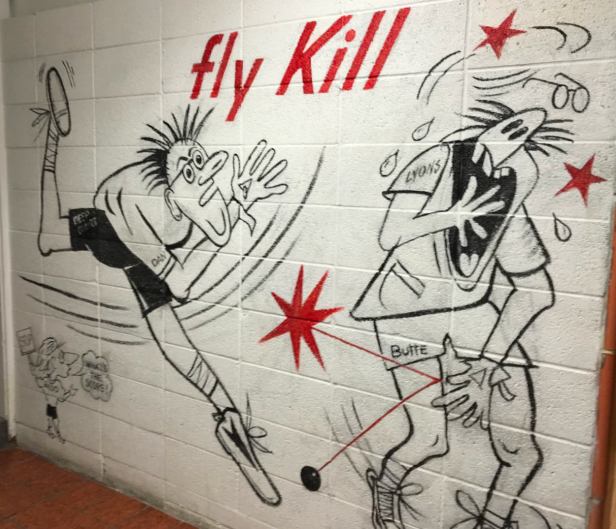
Ferriter painted the mural, titled, “Fly Kill,” on the outside wall of the shower in the basement of the Butte Elks Lodge. The painting featured Dan Sullivan hitting a handball into a very sensitive location of his opponent, Jerry Lyons.
A “fly kill” usually means hitting the ball, and killing it, before it bounces. Not in this case.
The caricature mural was first painted in 1982, painted over and then repainted. It depicted a pair Butte handball icons in Sullivan and Lyons. They were two of the best players in the Mining City in their day, and that was saying something back then.
Winning a city title then was probably tougher than winning a state title today. That was back when Butte was the Mecca of handball.
Sullivan stopped Lyons’ bid for three straight city titles with a 21-16, 12-21, 21-6 win in the championship match of the city tournament at the Elks on Sunday, April 8, 1973.

A year later, Sullivan won it again, beating a young Butch Starin 21-11, 21-11 in the championship match. In 1975, Butch won the first of his several city crowns. Lyons had won it three out of four years before his run was halted by Sullivan.
The romantic in me would like to think that Ferriter’s mural came from an actual incident, but I do not know that to be true. We can say for sure, however, that John Badovinac’s character was true to life. The painting showed a very small Bado with a sign asking the score.
Bado has never been too shy to ask the score.
If there is a better painting of three Butte characters out there, I have not seen it.
Sadly, we lost one of those characters last week with the passing of Sullivan at the age of 86.
The 6-foot-6 Sullivan was larger than life in so many ways — so much so that one nickname would not suffice.
To so many, Sullivan was known as “Dusty Dan,” and that seemed to fit as good as any nickname ever handed out. When you hear “Dusty Dan,” it is impossible to not smile.
He could entertain us with his quick wit or a song. Before we had karaoke, we had “Dusty Dan.” He could sing “I Left My Heart In San Francisco” better than Tony Bennett. In fact, he was such a good signer, that he had an opportunity to pursue that as a career in the 1960s.
However, Dan said he did not like the lifestyle of the average entertainer.
So, he saved his singing for us. If you stopped by one of the bars at the Elks or at the Deluxe Bar, you just might hear Dan belting out a tune. Later in life, he would perform at the Belmont Senior Center or retirement and nursing homes.

During the COVID lock down, Sullivan said he learned 90 songs so he could keep his performances fresh, and he always left the crowd begging for more.
One night many years ago, Sullivan played a baseball game against Charlie Pride’s team in East Helena. After the game, the two sang together in a bar.
“He was a Western singer,” Sullivan said of Pride when he appeared on the ButteCast in February of 2023. “I’m more of the (Frank) Sinatra, Tony Bennett guy.”
He also had an opportunity to possibly try out for the NBA, back before the salaries for the players were astronomical. About that time, though, Sullivan lost both of his parents, and he ended up joining the Army.
“Being realistic, I didn’t think I could make it,” Sullivan said of his NBA prospects.
While he did not turn basketball into a career, that sport is what gave Sullivan his other major nickname. To those who watched the Montana Grizzlies play basketball in the early 1960s, the 1958 Butte Central graduate was known as “Deep Court Dan.”
That moniker was given to him by Missoula sportswriters who watched Sullivan knock down shots from deep in the court. That was well before the 3-point line was brought into the game.
That nickname perfectly carried over to handball, where “Deep Court Dan” was known to kill the ball from the back of the court.
“I think it came from baseball,” Sullivan said of his deadly handball shot. “I played a lot of shortstop, believe it or not. It was the same swing as the throw. I think it was the throw from shortstop to first base that allowed me to kill the ball. That was my forte, killin’ it. I didn’t want to run around.”
Sullivan did not just play baseball and basketball. He starred in those sports. After helping Butte Central win the 1956 state championship in basketball, he went to the University of Montana, where he was a multi-sport athlete along with his former rival, the great Bob O’Billovich.
O’Billovich, who led Butte High to state hoops crowns in 1957 and 1958, played football, basketball and baseball for the Grizzlies. Sullivan played basketball and baseball.
Each lettered three times in each sport, and both were inducted into the Grizzly Sports Hall of Fame.
Sullivan and O’Billovich also roomed with each other at the school, and that turned a few heads in the day. In addition to coming from arch-rival schools in Butte, Sullivan was Catholic. O’Billovich was Serbian Orthodox.
“That was a pretty big deal,” Sullivan said. “After about a day, it seemed like we ran around together. We just melted into a personality. It was meant to be, I guess.”
After college and the Army, Sullivan got into handball. In addition to his victories over Starin and Lyons, he once beat the great Bill Peoples. According to legend, the non-tournament defeat was the only one suffered by Peoples to a Montana player from 1973 through 1983.
The ultra-competitive Peoples could not wait to get back in the court with Sullivan.

“I gave him a rematch, and of course he beat me,” Sullivan said of the summer match. “There was a big crowd because it got around town, and I knew I was in for a bad deal. They found out that I beat him, and he wanted a rematch right away. So the next week, I saw all those guys up there, and I thought, “Awe man.”
Others called Sullivan “Sully” or “Sull.” Many, many more called him “Mr. Sullivan” from his decades teaching at Butte High School. His law class was legendary. He would take students to trials and to the prison.
That class, which was as fun for the teacher as it was for the students, used to fill up in the blink of an eye.
Sullivan, who used to play golf with Evel Knievel, kept hitting the golf course four days a week into his 80s. He also kept singing, and he kept making us smile. We will always smile when we hear his name.
In the name of progress at the Elks, a renovation project called for the removal of the wall with Ferriter’s mural. Had I known that would happen, I might have chained myself to it like Brian McGregor did with the Greek Café.
Fortunately, a photo of the mural was turned into a shirt that you can buy at 5518 Designs in Butte. Unfortunately, the names “Dan” and “Lyons” were removed, but it is still a great reminder of three Butte legends.
It is a great reminder of Dan Sullivan, a man who could not be described with just one nickname.
It is just too bad that mural wasn’t painted in a better location.
— Bill Foley, who doesn’t even have one cool nickname, can be reached at foles74@gmail.com. Follow him at twitter.com/Foles74 or Bluesky at @foles74.bsky.social. Listen to him on the ButteCast on Apple Podcasts, Spotify or wherever you find your favorite podcasts.
-
Leskovar Honda Athletes of the Week: Copper City Senior All-Stars

The Copper City Senior All-Star softball players are this week’s Leskovar Honda Athletes of the Week.
In an era where travel ball often dominates the softball landscape, the Copper City Little League Senior All-Stars proved that heart, hard work, and hometown pride can still compete on the biggest stages. Representing Butte and Copper City at the Western Regional Tournament in Missoula, these young women played with determination, unity, and pride while making history along the way.
Leading the charge were Reese Johnson, Kendallyn Schad, and Avery Barsness. Their journey has come full circle. The trio were members of Copper City’s first-ever 9-10 All-Star team in 2019, and are now part of the first Copper City team to defeat Hawaii at the Western Regional Tournament, an accomplishment that will forever be part of the program’s history.
Johnson set the tone from the leadoff spot all tournament long, batting an impressive .548 while scoring 22 runs. Her ability to lead by example, stay composed in big moments, and encourage her teammates helped set the standard for the entire team throughout the tournament.
Schad was one of the most dangerous hitters in the tournament, posting a remarkable .697 batting average while driving in 29 runs. Time and again, she delivered in key situations and provided leadership both on and off the field.
Barsness was a steady presence in center field and one of the defensive anchors for Copper City throughout the tournament. Her athleticism, instincts, and ability to track down balls in the gaps helped shut down opposing offenses and save countless runs.
The team’s lone junior, Cliry Conway, showcased a quick glove at third base and played a key role in three double plays. Her defensive instincts and poise helped stabilize the infield throughout the tournament.
In the circle, Brea Henderson was nothing short of outstanding. Henderson pitched 38 innings during the tournament, striking out 46 batters while consistently giving her team a chance to win. Her performance reflected not only her talent but also the countless hours she dedicates to improving her game during the offseason.
Taylor Regan contributed in every phase of the game, batting .395 while using her speed to become a constant threat on the bases. She crossed the plate 17 times and provided energy whenever she stepped onto the field.
Behind the plate, Lilly Sandoval embraced one of the toughest jobs in softball. Catching 10 of the team’s 11 games in intense summer heat, she worked tirelessly to block pitches, and keep balls in front of her. Through it all, she never complained and consistently put the team first.
Aspen Shaffer provided valuable versatility throughout the tournament. She pitched 15 innings and recorded 18 strikeouts while also contributing in the outfield and as a runner whenever called upon. Her willingness to do whatever was needed exemplified the team’s selfless attitude.

Rounding out the roster were Savannah Stosich, Kessler Svejkovsky, and Keelie Schad, each making important contributions to the team’s success.
Stosich batted .344 and was a defensive standout at shortstop, helping turn four double plays during the tournament. Svejkovsky came through in clutch moments as the designated player, collecting five RBIs while also stepping into the circle to close out games when needed. Schad provided steady defense in right field and delivered several impactful hits that helped keep innings alive and drive team success.
While the statistics are impressive, the true story of this team goes beyond the numbers. These girls represented Butte, Copper City Little League, their families, coaches, and community with pride. They played for one another, battled through adversity, and showed what can be accomplished through dedication and teamwork.
The Copper City Senior All-Stars leave behind a legacy that future players can look up to. From being part of the inaugural 9-10 All-Star team to making history at Western Regionals, this group has helped raise the standard for Copper City softball and inspired the next generation of players who dream of following in their footsteps.
Since the beginning of 2023, Leskovar Honda, home of the non-commission sales staff that always has your back, has teamed up with the ButteCast to honor the finest student-athletes from the Mining City to encourage more children to get up, get out and try all kinds of sports and activities.
-
No 370: Remembering Dan Sullivan

There are legends, and then there are legends.
Dan Sullivan fell into the latter category. He was a legend among legends. He was a Butte Sports Hall of Famer and a Montana Grizzly Hall of Famer.
He was a Hall of Famer in life.
Dan passed away Thursday night at the age of 86, and we already miss him. We miss the stories. We miss the laughs. We miss the singing.
Dan was such a legend that one nickname wasn’t enough. He was widely known as “Dusty Dan” and “Deep Court Dan.” I always thought the “Deep Court” moniker came from his days in the handball court, where he was known for rolling the ball out from deep in the court.
As it turns out, however, that nickname came from a writer in Missoula who noted that Dan could score the basketball from very deep in the court. So, the nickname was fitting for two sports.
Dan graduated from Butte Central in 1958. He was a basketball star for the Marrons before playing basketball for the Grizzlies. At the University of Montana, Sullivan roomed with his good friend and Butte High Bulldog legend Bob O’Billovich.

After serving in the Army, Dan ended up teaching for decades at Butte High School. His law class used to fill up faster than a Springsteen concert sold out. He was that popular as a teacher.
In February of 2023, Dan met me inside the Vault at the Metals for a great conversation.
After his passing, I figured today would be a great time to bring back his episode of the ButteCast. I figured it will be for all of us to hear the voice of Dan Sullivan one more time.
I will have more on his passing in my next column. It is going to take a few days to digest.
Funeral arrangements are still pending. I encourage all individual members of the Butte Sports Hall of Fame to wear their Green Jacket when attending the funeral.
Today’s episode is presented by Thriftway Super Stops. Download the TLC app and start saving today.
-
Episode No. 369: Reece Cox

If a guy could make a living coaching American Legion baseball, then today’s guest would be a lifer. Reece Cox just seems like he was born to coach youth baseball.
In fact, the calling was so strong that Reece put off starting his career as a physical therapist in Denver for a few months so he could coach the Butte boys one more summer.
For the past decade or so, Reece has been one of the most influential people involved in the revitalization of the Butte Legion program.
He started as a player during the first year of 3 Legends Stadium in 2017. He was part of Butte Miners teams that came within one game of the Class A State tournament three years in a row.
The year after his playing days ended, he was a coach in the program as the Miners won the district, state and regional titles in 2022.
Reece has coached the Butte Motormen and Butte Muckers, the two feeder programs for the Miners. He has helped develop players, and his teams have won a lot of games. They have won a whole lot more than they lost.

Today, Reece is in the process of moving to Denver to start his career as a physical therapist. This comes after the 2020 Butte High graduate earned his degree and credentials at the University of Montana.
He says this is a great opportunity for him to work hard to become the best physical therapist as he can be, but he says he will be back in the Mining City someday.
Last evening, I met with Reece at the Jack Crowley Clubhouse at the Highland View Golf Course for a fun conversation.
Listen in to learn that there is an art to taking a bean ball, something that Reece did better than just about anybody.
Listen to hear why Reece postponed that career start to coach the Legion baseball team. Listen as Reece describes PT as basically just another form of coaching.
Listen in to hear that Reece is undefeated in fights with his younger brother, Quinn, an accusation Quinn vehemently denies.
Listen in to hear how Reece’s older brother, Shane, is deadly throwing playing cards. Listen in to why Reece decided to go into physical therapy in the first place.
Like with coaching baseball, this just might be a calling.
Today’s podcast is presented by the Jewelry Design Center. Let Brian Toone and Co. be your jewelers for life.
-
No. 368: Remembering Don Peoples Sr.

This past weekend, we celebrated the induction of the Butte Sports Hall of Fame Class of 2026.
This class of 12 individuals and five teams was the 20th class for the local shrine, which welcomed its first class of Butte sports immortals in 1987.
Notably, it was the first class without its founder, Don Peoples Sr.
Peoples, who served as chief executive of Butte-Silver Bow from 1979 until the summer of 1989, came up with the idea for the Butte Sports Hall of Fame during a conversation at a county Christmas party. He said he woke up the next morning, and it still seemed like a great idea. So, Peoples called Pat Kearney, and the rest is history.
Peoples was also the chief executive who helped guide the Mining City through the tough economic times of the 1980s. He is the man who named us the “Can-Do City” and he pushed for Butte to be named an “All-American City.”
Peoples was the patriarch of a great family full of athletes, coaches and some just awesome people.
During the Butte Sports Hall of Fame induction banquet Saturday night at the Butte Civic Center, I said a few words about Peoples, who passed away at the age of 86 on March 18. Instead of a moment of silence, we gave him a long ovation to show our appreciation for all his great work.
In light of that induction, which included his son, Don Peoples Jr., I decided to bring back the Don Peoples Sr.’s episode of the ButteCast. Mr. Peoples welcomed me into his home nearly four years ago to talk for my very first episode. That episode debuted on Sept. 12, 2022.
At the time, Peoples Sr. was still riding a high from his grandson Dougie’s 27-foot buzzer-beating shot that gave Butte Central the Class A State boys’ basketball title that March.
Listen in as Peoples talks about that legendary shot, his family and his work to help Butte survive the 1980s.
Today’s episode is presented by Leskovar Honda, home of the friendly non-commission sales staff that always has your back.
-
The secret of Coach Street’s success
Following the 1997-98 wrestling season, Jim Street stepped down as the head coach of the Butte High Bulldogs.
He made a brief comeback as head coach a few years later, but the news sent shockwaves around the country in early 1998.
At the time, I was working as a sportswriter for The Moscow-Pulman Daily News in Idaho. I heard the Street news when one of the wrestling coaches from one of the high schools I covered called me at the sports desk.
The coach knew that I was from Butte. Apparently, Butte Rats wear that fact on their sleeve like we are combat veterans or belong to a CrossFit gym.
He wanted to know if there was any possibility that the Butte School District would hire a replacement from outside the program. He was thinking about applying for the job.
He also asked me a lot of other questions about Butte, the school and the program. He eventually asked if I knew what Street’s secret to success might be. Even great coaches were impressed with Coach Street.
Not many coaches at any level enjoyed the success of Jim Street. His Bulldogs won 13 straight Class AA State championships form 1980 through 1992. His teams also won it all in 1995 and 1997.
But I had no idea what made Street so great.
At the time, the only thing I knew about Coach Street was that you did not want to have a can of chew in your pocket when you walked by his classroom at Butte High. He could snuff out a can of snuff like Smokey Bear on a fire.
I was nervous walking by his room, and I never chewed.
The only thing I knew about wrestling was that I did not want to do it. It never looked like any fun.
When I watched people wrestle, it looked painful and uncomfortable, even for the winner. Plus, your nose can end up in places where no nose should ever venture.
Seeing Butte High win the state title every February, though, was always one of the highlights of the year. Even though Butte was suffering through an economic depression under “Reaganomics” in the 1980s, that was our yearly reminder that the Mining City was still the toughest city in the state.
And there was no better frontman for that toughness than Coach Street.
It was not until years later that I got to know Coach Street and started to begin to understand his greatness.
In 1998, though, I did not have an answer for the coach asking about Street. I figured he was just a great teacher and motivator, which he clearly was and still is.
Sure, his teams were loaded with talent, toughness and knowhow thanks to all the great coaches in the Butte Wrestling Club. He was coaching a bunch of hardnosed wrestlers who were raised in a rough-and-tumble mining town.
But it takes a lot more than talent and toughness to win a state title. Winning multiple championships is something not many people ever do. Winning 13 straight is next to impossible.
For the Butte High Bulldogs, that Purple Reign all started with Coach Street, a no-nonsense coach who perfectly blended the old school with the new.
When I first started school at Butte High, I thought the wrestlers were all afraid Street. However, I quickly learned that was not necessarily the case.
Those wrestlers were afraid, alright. They were afraid to let their coach down.
There was an expectation of greatness from every wrestler who put on that Bulldog singlet, and they all felt the extreme amount of pride and pressure every time they put it on. That goes for even the greatest Bulldog wrestlers, too.
That was not because the coach placed unrealistic expectations on the wrestlers. It was because the coach, his staff and his wrestlers set the bar by winning. The people of Butte simply expected them to win a state title each February.
They knew second place was a disappointment.
The standard was set so high, and they knew it was going to be extremely difficult to live up to it. Yet, year after year, the Bulldogs did just that. When the dust settled, the Bulldog were taking a firetruck ride around town to celebrate another title.
It was a run like nobody has ever seen before or since.
Yes, Street is a great teacher and motivator. He studied the sport and the science behind it, always staying a step ahead of the competition. He lived and breathed wrestling. He still does.
That, though, was not the secret to his success.
After seeing his 14th championship team enter the Butte Sports Hall of Fame over the weekend, I think it is abundantly clear that Street’s biggest strength is how much he cares about his wrestlers. That bond between the coach and his athletes did not end when they hoisted the championship trophy, either.
It did not end when the wrestlers graduated from high school. It did not stop when Street retired. He cared about them then, and he cares every bit as much about them now.
He will care deeply about each and every one of them until he takes his final breath.
Almost every living member of the 1995 team made it to the Butte Sports Hall of Fame induction at the Butte Civic Center. They did that because they did not want to let down the coach they love and respect so much.
Coach Street did not want to let them down, either.
By the time of the Green Jacket Ceremony on Friday night, most people heard that Coach Street and his wife, Barbara, were both seriously injured in a motorcycle crash on July 17. They knew they were both hospitalized in Billings, where Mrs. Street remains.
Not a single person, however, was surprised when Coach Street walked through the front door of the Butte Civic Center on Friday night, donning his Butte Sports Hall of Fame Green Jacket.
He had a few bruises and scrapes, and he was still a little foggy from what is likely a concussion sustained in the accident just seven days earlier. But he was still Coach Street. He still owned the room.
There was hardly a dry eye in the place when Street walked down the aisle as one of the returning “Green Jackets” to start the ceremony.
I could hardly see through teary eyes as, in my duties as the master of ceremonies, I welcomed the coach with the following words:
“He was an outstanding football player and wrestler at Butte High. As a coach, he is a legend well beyond the Butte city limits. His Bulldogs wrestling teams won 13 straight Class AA State titles and 15 overall, all while showing off a toughness and grit that could only come from the streets of the Mining City. Please welcome Jim Street.”
Later that night, Street led his 1995 state champions down the aisle to a thunderous applause.
Everyone was blown away to see him there. Some wondered if he should have been making the trip. Not a single person was surprised.
Coach Street showed up for his wrestlers. Even though they are all in their late 40s, the coach did not want to let them down. He simply had to be there for them.
Those wrestlers knew he would crawl over broken glass for them in 1995. They know he will still do it 31 years later.
You want to know the secret of Coach Street’s success at Butte High School? Well, there you have it.
In Butte, though, that was never much of a secret.
— Bill Foley can be reached at foles74@gmail.com. Follow him at twitter.com/Foles74 or Bluesky at @foles74.bsky.social. Listen to him on the ButteCast on Apple Podcasts, Spotify or wherever you find your favorite podcasts.
-
Leskovar Honda Athletes of the Week: Noah Powers and Hannah Black

Butte Miners pitcher Noah Powers and bowling standout Hannah Black are this week’s Leskovar Honda Athletes of the Week.
Powers takes home the boys’ award after an outstanding season on the bump for Butte’s top American Legion baseball team. The soon-to-be Butte High junior led the Miners in innings pitched, strikeouts and earned run average.
He posted a 2.03 ERA on the season, fanning 33 batters in 38 innings. That included four innings Friday as Butte beat Dillon 16-6 in a loser-out game at the Southern A District Tournament at 3 Legends Stadium. He did not give up an earned run in the outing.
Powers, who can also play the hot corner, had a strong season for the Butte High baseball team this spring as well, splitting time between the varsity and junior varsity squads.
Black receives the girls’ honor after placing fifth in the U12 girls’ division at the 2026 Junior Gold Championships in Minneapolis. The division featured 122 bowlers from around the country. Her two losses in match play came to Stevie Newton of Hanover Pennsylvania and Kailynn Melvin of Tonganoxie, Kansas. They finished first and third in the tournament.
Hannah posted an average 168 for the national tournament, and she became the first Montana bowler to ever make it to matchplay at that age level at the Junior Gold Championships.
Black, 12, is a five-time Pepsi champion and a three-time Junior Gold competitor. She is also active in dance and volleyball. She will be an eighth grader at East Middle School this fall.
Since the beginning of 2023, Leskovar Honda, home of the non-commission sales staff that always has your back, has teamed up with the ButteCast to honor the finest student-athletes from the Mining City to encourage more children to get up, get out and try all kinds of sports and activities.
Photo of Powers courtesy Alycia Holland Photography.

