
-
She’s a big reason why this place is ‘Mountain Bike Heaven’

As he stopped for a break from his many trips riding his mountain bike around Big Butte, the cyclist looked around and nodded his head in approval.
He is a retired Butte native who usually visits his old stomping grounds for several weeks each summer. The area behind the “Big M,” as we call it, is much different from the days when he lived in the Mining City.
It is much different than it was a decade ago.
Not long ago, you were as likely to find an abandoned couch as you were someone riding a mountain bike. You saw more old tires than people.
Today, though, the area is alive and well. It is full of people walking their dogs, running or riding their bikes.
As I took a break from walking my dogs last summer, the cyclist and I stopped and talked on a trail that is part of a huge high school cycling race each fall.
“This,” he said, “is Mountain Bike Heaven.”
It was almost if he was asking me a question, like when “Shoeless” Joe Jackson asked Ray Kinsella if Iowa was heaven.
I had never thought of it that way, but the rider was right. If you like to ride mountain bikes on trails, there are not many places that beat Butte and Southwestern Montana. It is also “Running Heaven,” “Hiking Heaven,” and “Dog Walking Heaven.”
Butte-Silver Bow Chief Executive J.P. Gallagher is a big reason for this. He was the director of the Butte-Silver Bow Parks and Recreation Department before he ran for the top job, and he helped lead an effort to clean up the area behind the M.
He was also part of the great effort to build miles of trail behind the M. Some of those trails followed the skinny paths people made by walking through the area. Others were new trails cut through places that were almost impassable by foot in years past.

The M is not the only place with great trails. We also have the Maud S. Canyon Trail and miles and miles of trails for riders at Thompson Park, thanks, in large part, to the work of Jocelyn Dodge, a retired recreation forester with the Butte Ranger District.
The biggest reason that we now live in “Mountain Bike Heaven,” though, is because of the Butte 100 Mountain Bike Race. That race sparked a cycling explosion in Southwestern Montana, and trails had to be made to accommodate the many riders.
That race will ride for the 18th time this Saturday, starting and finishing near Homestake Lake. Riders can compete in the 100-mile race, a 50-mile race or the 25-mile race, which is named in honor of the late, great Dr. Pete Sorini.
The race started in 2007 and has taken place every year but the COVID summer of 2020.
Bob Waggoner, who used to own and operate Bob’s Bike Repair, founded the race, and he turned to Gina Evans to build, plan and coordinate the event.
He could not have made a better choice.
The first race got 41 riders to compete, and it started at Montana Tech. Really, 41 was kind of a big deal then, too, since most people around here figured someone would have to be mentally ill to race a mountain bike 100 miles through the mountains.
Now we have a 100-mile running race.
By the fourth year, the race found its permanent home, starting and finishing near Homestake Lake.
It did not take long for the number of racers to grow. It soon swelled to 350 riders before the capacity was raised to accommodate up to 500 riders.

It really is a spectacle to see the army of volunteers and the many, many riders at the finish line. The cowbells ring to sound the alert that a rider is approaching the finish line. The best way to describe it is to say it is “organized chaos,” and it really is a thing of beauty.
Gina served as the race director — a mostly volunteer position — for the first 11 years of the race. She would take one month off after each race, and then get back to work for the next year.
She did not put in all those long hours so she could ride in the race. She would have loved to race, but she loved spreading the joy of cycling even more. For Gina, this was her passion project. It was never for honor or prestige.
Of course, she got a ton of help because it takes an incredible amount of people to pull off such a big event. There are just too many to name them all.
When I asked her for a list of instrumental helpers running the race, Gina sent me so many names that it would have almost been easier to publish the phone book. It would have at least doubled the size of this column.
Gina called them the “Neon Army” because of the sea of neon shirts that fills the course and the start/finish area each year.
The amazing thing is that Gina continued to direct the race even after she was nearly killed in a hit-and-run incident in June of 2010. While riding her bike down Continental Drive, Gina was hit by a large truck.
The driver of that vehicle was never found, and Gina has undergone nine surgeries because of it. She likely faces even more.
Her comeback from the hit-and-run also included countless hours of physical therapy, post traumatic stress disorder, sleepless nights, and aggravating battles with insurance companies.
After Dr. Sorini passed in early 2016, Waggoner sold the race to the legendary neurosurgeon’s family. That includes his wife, Stephanie, and daughters, Gia, Marietta and Bella. With help from many of the same army, the Sorini family has kept the race thriving.
Gina decided to step down as director in 2017, and Stephanie Sorini is now the race director. Gina had just done too much, and the surgeries were still mounting.
But she continues to direct Pete Sorini Trail Day, a cleanup event of the Continental Divide Trail that Gina helped start. The event marked its 10th year this June.
Not only does that day help the Butte 100, it makes it possible for everyday people to enjoy the trail during the summer.
Until her medical problems prevented it the last couple of years, Gina owned and operated Linked Adventures, a service that shuttles bicyclists, runners and hikers into the mountains and trails of Southwestern Montana. Someday soon, she will re-open that business.
Even though she is unable to rider her bike, she devoted her career to making it possible for others to enjoy “Mountain Bike Heaven.” Here entire existence, it seems, has been to serve others.
She has worked on bike safety for our youth, and helped land grants for safe routes to school. And she helped start the Copper Sprockets youth cycling team.
She’s done so much that they should at least name a trail after her.
Since that first Butte 100 in 2007, cycling has exploded in Butte as more and more people realize what we have in our back yard.
So many people have been instrumental in this growth. The cycling community is full of good-hearted people willing to lend a hand and offer encouragement.
In my book, though, nobody has ever done more for cyclists in Butte than Gina.
Nobody has done more for runners, either. Or hikers. Or dog walkers.
So, the next time you see Gina when you are enjoying these trails, stop and tell her thank you.
— Bill Foley, who still thinks you have to be a little messed up in the head to race a mountain bike 100 miles in the mountains, can be reached at foles74@gmail.com. Follow him at twitter.com/Foles74 or Bluesky at @foles74.bsky.social. Listen to him on the ButteCast on Apple Podcasts, Spotify or wherever you find your favorite podcasts.
-
Butte High cross country team store open for limited time

The Butte High cross country has opened its team store for team members, family and fans in the community to purchase Bulldog gear.
Exclusive apparel for sale includes T-shirts, long-sleeve shirts, hoodies, shorts, pants, bags and more. The shop closes on July 21, so order soon to receive your Bulldog gear by the start of the 2025 season.

-
Dogs set football camp for Aug. 4-6
The 2025 Mile High Football Camp will be held Aug. 4-6 at Naranche Stadium.
The camp for pre-kindergarten through eighth grade will run from 9 to 11 a.m. Monday through Thursday that week. Cost is $60.
Campers will receive a camp T-shirt and fundamental skills instruction. Players should dress in football cleats, a shirt and shorts.
The camp will be conducted by the Butte High football staff, and registration forms can be brought to the first day of camp. Click the link below for a registration form.

-
Leskovar Honda Athletes of the Week: Ryan Olson and Trapper Stajcar

Copper City Softball player Ryan Olson and Butte Miners baseball player Trapper Stajcar are this week’s Leskovar Honda Athletes of the Week.
Olson takes home the girls’ honor for her part playing for the Copper City 12U All-Star team at the District 2 tournament in Great Falls. Ryan went to bat 11 teams, and she turned that into four hits. That includes three singles and a triple. She drove in three runs.
Ryan was also stellar on defense at shortstop for the Butte girls. She turned a slick double play, snagging a line drive before throwing back to Brinkley Greer to get the second out on first base.
Ryan is a soon-to-be eighth grader at Butte Central.

Stajcar takes home the boys’ award after suffering what is feared to be a season-ending injury.
The soon-to-be senior at Butte Central senior leads the Miners with a .458 batting average. In 22 games, the speedy outfielder registered 27 hits. He drove in 11 runs and scored 20 times.
Batting mostly from the leadoff spot, Trapper struck out just five times. He also swiped 19 bases. Defensively, Trapper chalked up 19 put outs and two assists while posting an .875 fielding percentage.
With two seasons of Legion ball remaining, Trapper’s story is still a long way from being completed.
For the third year, Leskovar Honda, home of the 20-year, 200,000-mile warranty, is teaming up with the ButteCast to honor the finest student-athletes from the Mining City to encourage more children to get up, get out and try all kinds of sports and activities.
-
Podcast No. 276: Maritsa Georgiou

Maritsa Georgiou is a well-respected journalist in Montana and around the nation.
Her reporting on the planned removal of United States Postal Service boxes leading up to the largely mail-in election of 2020 earned her the Walter Cronkite Award for Excellence in Television Political Journalism. It might have also thwarted a conniving attempt to swing the election.
A year earlier, the Montana Broadcasters Association awarded her the E.B. Craney Award for Television Broadcaster of the Year.
Maritsa started working for NBC Montana when she was still a junior at the University of Montana in 2006. She worked there until 2021, when she moved on to Scripps News to work as a national correspondent. She also anchored “America Tonight,” before losing her job when Scripps eliminated more than 200 employees during a mass layoff last November.
Maritsa grew up in St. Louis Park, Minnesota, which is a suburb of Minneapolis. She came to Montana to study at one of the best journalism schools in the country. She also arrived in the Treasure State with some serious Montana roots.

Those roots include her grandfather, Barry ZeVan. Many years before he was the famous “Peek-a-Boo” weather man in Minnesota, ZeVan worked as Missoula’s first television meteorologist. Before that, ZeVan worked for KXLF Radio in Butte.
Early in 2025, Maritsa teamed up with another newly-unemployed Montanan, former Sen. Jon Tester. Together, they created the “Grounded” podcast. It is a widely entertaining podcast with some exceptional — and important — conversation and journalism.
Also, with their combined credentials and connections, Maritsa and Sen. Tester have some serious reach for guests. Recent guests include former Montana Gov. Marc Racicot, former Secretary of Transportation Pete Buttigieg, “Anonymous” op-ed writer Miles Taylor, and New Jersey Sen. Cory Booker.
The episode with Sen. Booker dropped earlier this week. In addition to some hard-hitting heckling between Tester and Booker, Maritsa and Sen. Tester got to the bottom of how Sen. Booker pulled off a 25-hour filibuster in the U.S. Senate without once using the restroom. He wasn’t wearing a diaper, either.
Generally, the interviews are conducted with Maritsa working from home in Missoula and Sen. Tester on his phone — and sometimes struggling mightily with technology and connections — while working on his farm in Big Sandy.
It quickly turned into my favorite podcast, other than the ButteCast and Mad About Montana Podcast, that is.
Listen in to today’s podcast as Maritsa talks about the influence of her grandfather in her career and why she chose to come to the Treasure State to study. Listen as she talks about the story that won her the Cronkite Award.
Listen as she talks about working with former Sen. Tester and why the Big Sandy farmer is the genuine article.
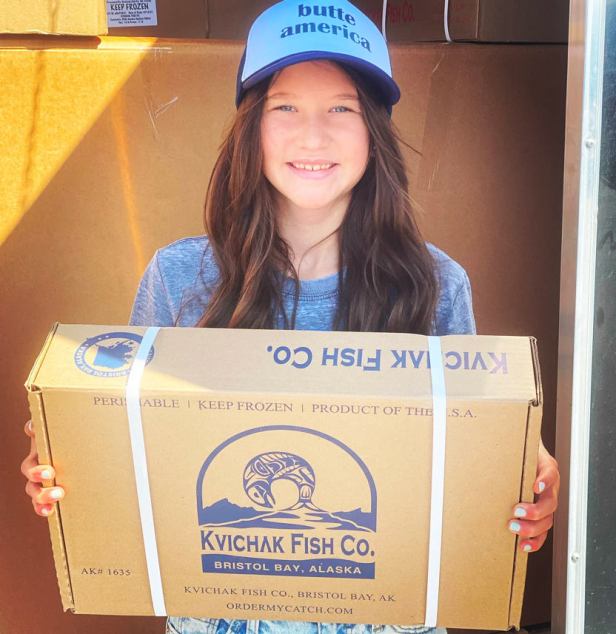
Today’s podcast is presented by the Kvichak Fish Co. Think of it as salmon and halibut gone Girl Scout cookie. Place your order today.
-
Sparky’s voice will live on forever
The April Fool’s Day column of 2014 on ButteSports.com was so over the top that I did not think anybody would believe it.
That was the column where I wrote that Arie Grey stepped down as Butte High’s football coach to take over the swimming program at the University of Great Falls, which is now the University of Providence. The joke said that Grey would be replaced by longtime Butte Central assistant Doug Peoples.
Nobody bleeds the color of his school more than Doug, so I certainly figured nobody would possibly believe that he would cross over to the Bulldogs. The column said that Doug planned to bring back the Butte High vs. Butte Central football game, and suggested that the schools were already fighting about where to play the game.
At the time, we were only a few years removed from the fight about playing a basketball game at the Maroon Activities Center.
Unfortunately, one of the renovations of ButteSports.com erased the comments below the old columns and stories. That comment section is where I learned that at least one person fell for the prank column, even though I thought I had made it obvious that it was an April Fool’s Day gag.
That person was the legendary Old Hippy himself, Rick Sparks.
“Sparky,” as he was affectionately known, expressed shock that Doug would take the job because he knew of his strong allegiance to the Maroons. But, Sparky, a former Butte Central assistant football coach, wished Doug luck in his new endeavor.
Then someone let Sparky in on the joke, and he commented one more time.
I cannot remember exactly what he said, but I’m pretty sure it started off like this: “You son of a …”
It was the only time that I was glad Sparky was not living in the Mining City at the time.
Sparky passed away last Tuesday night. He died just three days shy of his 78th birthday, which as the Fourth of July. The news of his passing shot through town like a shockwave of sadness. That sadness eventually gave way to smiles because, even in talking about his death, talking about Sparky makes you smile.
Everybody seemed to love Sparky, who moved back to Montana after two and a half decades teaching in California looking like a member of the band ZZ Top.
Before he left town in the mid 1980s, Sparky was a big, burly guy with a thick, but shorter beard. He returned as the skinny Old Hippy, as Tim Norbeck put it. Norbeck played football for Sparky at BC in the early 1980s.
Sparky just looked like a hippy. I do not think he was one. He also spoke softly after he moved back to Butte, but that is not necessarily how he was remembered by the athletes Sparky coached in football, track and wrestling.
For much of my career as a sportswriter, Sparky was a legend whom I had never met. I heard stories, and some of them were hard to believe.
Finally, sometime in the first decade of the 21st Century, I met Sparky on the sideline of a Butte Central football game at Bulldog Memorial Stadium. Norbeck introduced us, and I immediately liked Sparky, who was nothing like I expected.
We talked every time we saw each other at a game until Sparky moved to Missoula. Then, we would talk on Facebook or in emails.
When I started the ButteCast, Sparky was one of the first names I wrote down when making a list of prospective guests. He was also by far the most requested guest — mostly by the men and women he coached.
One of my favorite things about hosting that podcast is that it gives me a chance to be a part of some great conversations that will last forever. The voices on those podcasts will never die, and Sparky’s voice is one of them.
He was a guest on episode No. 42. We met at the Knights of Columbus Hall and talked for about an hour. He was in town to watch his grandson, Mario Rosemond, play basketball for Missoula Hellgate against Butte High.
Sparky was on his game that day in January of 2023. He talked about the great teams he was a part of as a player and a coach.
To his core, Sparky was a Bulldog. He was an All-State center on Butte High’s undefeated State championship football team in 1964. He was a proud member of the Butte High Silver B’s.
Sparky went on to a successful career playing football at the University of Montana before he eventually returned home to teach and coach at Butte Central. He was the offensive coordinator for the Maroons during BC’s 18-16 overtime loss to Butte High in 1981.
Sparky was inducted into the Butte Sports Hall of Fame as part of that 1964 Bulldog team. He was also inducted as the coach of four State champion track teams — three for the girls and one with the boys — and one State champion wrestling team at Butte Central.
Sparky was inducted into the Hall of Fame individually in 2009. Sparky’s father, Bob Sparks, was inducted into the Hall in 1993. The elder Sparks spent years as a recreation director in Butte. He also coached Butte’s legendary independent football team, the Butte Buzzies.
“My dad had a huge influence on me,” Sparky said in the podcast.
“Were you like him as a coach?” I asked.
“Yeah, I think so,” Sparky said. “I don’t really recall of him being as goofy as I was.”
I asked Sparky about his 1964 Butte High teammates, guys like Jon McElroy, Jim Street, Ray Becky and Bill Sever, just to name a few. I asked which one was the toughest.
“I would probably say the toughest guy was Street,” Sparky said.
“Yeah, that would have been my guess because he still scares me,” I said.
Sparky laughed. He laughed a lot that day.
“Yeah, he does,” Sparky said. “He’s my very good friend, and he still scares me. And Becky, too.”
Sparky also talked about the time he poked a little fun at Sam Jankovich, Butte High’s notorious no-nonsense football coach, during a sketch at a school assembly.
“I played Jankovich, and everybody else played themselves,” Sparky said. “It was fun.”
Did Jankovich laugh at the skit?
“They say he did,” Sparky said. “I don’t know. I wasn’t hanging around.”
Sparky said that he wished he would have given the ball to Brian Morris one more time in that 1981 game against Butte High. That probably would have changed everything.
Then, Sparky brought up the column about Doug taking over the Bulldogs.
“I’ll never forgive you for tricking me that April Fools Day,” he said. “That’s funny.”

We had to cut the conversation off because Sparky had a game to go to. The podcast was — and still is — a hit. People bring up the Sparky episode all the time. They laugh at the stories he tells, and they were just glad to hear his voice.
Sparky had fun that day, too. I know that because he messaged me on Facebook shortly after to say thank you. He also said that he wanted to do a sequel episode because he had so many more stories to tell.
Of course, I said. Sparky was welcome any time for another appearance on the podcast. I told him to let me know the next time he was coming to town.
Unfortunately, that conversation never happened. Those stories are gone. At least they are in Sparky’s words. I will always regret not doing more to make that next episode happen.
However, at least I got the one Sparky episode, and it was great. You can hear why Sparky is the favorite teacher and coach for so many.
Sparky might be gone, but we can always go back to episode No. 42 of the ButteCast and listen in as his voice lives on.
— Bill Foley, who has also fallen for a few April Fool’s Day pranks, can be reached at foles74@gmail.com. Follow him at twitter.com/Foles74 or Bluesky at @foles74.bsky.social. Listen to him on the ButteCast on Apple Podcasts, Spotify or wherever you find your favorite podcasts.
-
Leskovar Honda Athletes of the Week: Kessler Svejkovsky and Lane Lisac

Copper City Softball player Kessler Svejkowsky and golfer Lane Lisac are this week’s Leskovar Honda Athletes of the Week.
Both of these outstanding young athletes will be eighth graders at East Middle School next school year.
Svejkovsky takes home the girls’ honor after an incredible performance playing for the Copper City 12U All-Stars in the District 2 tournament in Great Falls. In three games over the tournament, Kessler faced 72 batters. She struck out 32 of those batters, going 2-1 in the tournament. Kessler was also backed up by some great play from her teammates.
At the dish, Kessler turned 13 plate appearances into seven hits and five RBIs.
Lisac receives the boys’ accolade after winning the First National Bank junior golf tournament last Monday at Bozeman’s Riverside Country Club.
Lisac shot a 1-over-par 36 over nine holes to take the tournament title. The tournament was part of the First National Bank Junior Golf Tour, and Lane topped a field of 36 players in the boys’ 12-13 age group. He was just one of three boys to break a score of 40 over the nine holes.
For the third year, Leskovar Honda, home of the 20-year, 200,000-mile warranty, is teaming up with the ButteCast to honor the finest student-athletes from the Mining City to encourage more children to get up, get out and try all kinds of sports and activities.
-
Podcast No. 275: Ozzie Rosenleaf

Today’s guest is someone everyone knows. Or, at least you know of him.
He might just be the guy you see running down the street, no matter the weather. He is Donald “Ozzie” Rosenleaf, a 1991 Anaconda High School graduate who lives in Butte with his wife Sunvee.
Ozzie has reached one-name status in the Mining City. When people speak of him, there is no need to use his last name.
Usually that conversation about Ozzie goes something like, “Did you hear what Ozzie is doing?”
People think Ozzie is a little crazy because of his love of running. He has run more miles than Forrest Gump since the soon-to-be 52-year-old Ozzie took up running in his late 20s.

That includes running a full marathon in all 50 states in the nation. He ran five marathons in five states in five days. Then, he ran six marathons in six states in six days.
Even runners who other people are nuts think Ozzie is a little out there. He also as an inspiration for them and others to show that they, too, can do great — or crazy — things if they put their mind to it.
Ozzie’s most recent race was to run the Copper Kings 100 in Butte. That was a 100-mile race that Ozzie finished in just over 24 yours.
It was the third time that he ran a race of at least 100 miles. That goes with a marathon total that is approaching 100.
Listen in to hear Ozzie talk about finishing the 100-mile race. Listen as he talks about how he got into running in the first place. Listen to hear that Ozzie really isn’t that crazy after all.
Today’s podcast is presented by Casagranda’s Steakhouse. Eat Where the locals eat.
-
Podcast No. 274: George Parrett

When I was in grade school in Butte, there were basically two kinds of kids: Those who had Mr. George Parrett as their principal and those who wished they did.
I fell into the latter. I was never lucky enough to have Mr. Parrett as a principal, but I heard so much about him from the kids who did. They loved Mr. Parrett. They all spoke about him like he was their favorite uncle. The only other principal I ever heard spoken of in that way by other kids was Mr. Oakie O’Connor.
I was not lucky enough to have Mr. O’Connor as principal, either. I just missed him at the Kennedy.
Mr. Parrett, who turned 92 this past Saturday, spent decades as the principal, with the last 20 years or so coming at the Whittier Elementary in Butte. When he retired in 1998, Mr. Parrett spent another couple of decades plus serving as a volunteer at Whittier. He helped kids learn how to read or write.
He also became an avid runner during his retirement years, and he was a driving force in establishing the Spirit of Columbia Gardens Carousel. So, his legacy will live on for decades to come, and in more ways than one.

In recognition of his long career, Mr. Parrett was selected to serve as the Grand Marshal of this year’s Fourth of July Parade in Butte. It will be his second stint as Grand Marshal. He shared the honors for his work with the Carousel in the past.
Listen in to hear Mr. Parrett talk about growing up in the Great Depression in Butte. He was one of seven children who lost their father at a young age.
Listen as he talks about getting into teach and how he knew right away that he was going to marry Mrs. Parrett. Listen as he talks about some of his former students and some of the teachers and principals he worked with.
Listen in to hear why he was a great selection for Grand Marshal and why those kids were right to think they were lucky.
Today’s podcast is presented by Thriftway Super Stops. Download the TLC app and start saving today.
-
Let Bugs Bunny provide inspiration to stand up for sports officials
The fan was from Belgrade, but he could have been from any town in the country.
Right from the start, he was not happy with the umpires during Sunday night’s championship game of the Gallatin Valle Posse Roy McCauley Memorial Tournament in Three Forks. With the Butte Muckers leading 2-0 over the Belgrade Bandits B in the bottom of the second inning, the Muckers put on a double steal.
The throw to second was a close one, but the player for the Muckers (my son) was called safe by the umpire. It was the kind of play where every Butte fan thought he was safe, while every Belgrade fan knew he was out.
Those are the kind of plays that make the game exciting, and the umpires in American Legion Baseball do not get to challenge plays to the MLB command center in New York.
The angry fan, who was sitting just a few feet from me, let the young umpire have it. Even though he was in the grandstands behind home plate, he figured he clearly had a better view than the umpire who was a couple of feet from the tag.
“That’s terrible,” the fan yelled, opening his arms up to demonstrate his point. “Open your damn eyes.”
I looked at the guy, kind of amazed by his anger at a kids’ game — and in the first inning, no less. I just rolled my eyes, but I thought he reached the point where he should have at least been warned by the umpires or tournament officials that his actions could get him sent packing.
I have not called a single technical foul in three seasons as a basketball official, and I would have thrown him out of the game if he yelled like that at me or my partner.
After the dust settled and they eyes stopped rolling, the guy would not let the call go.
“We have three blind mice out there,” he yelled.
That’s when I decided it was time to step up and play the role of Bugs Bunny to the angry fan’s Yosemite Sam. I did not give him Bugs’ trademarked “Ahhh shaddap,” but my comments had the same sentiment. And probably the same tone.
“You know, you can sign up to be an umpire,” I told the guy.
“Yeah, maybe I should,” he shot back immediately.
My wife elbowed me to tell me to not get into a fight. Some guy from behind us said something like, “hey now, c’mon guys,” as if there were about to be a fight, and as if, somehow, I was equally at fault.
“It is not an easy job,” I said, “and this is exactly why we have a shortage of officials.”
Again, my wife gave me a look as if to tell me to shut up. I am sure that some of the fans sitting around us were thinking the same thing.
Given the chance to relive that uncomfortable moment, however, I would do it the exact same way. That guy needed to be told to shut up.
Since the guy, who I’m pretty sure was bigger than me, only uttered a few more comments, almost under his breath, the rest of the game, I feel that my words were effective.
The only thing I really heard him say the rest of the game was to repeat his earlier statement that, “We have three blind mice out there.”
If your go-to line for heckling is to reference a nursery rhyme that dates back to the 1600s, by the way, you should probably leave the banter for someone else. That, though, is a whole other story.
I was right when I told the guy that umpiring baseball is not an easy job. In Major League Baseball, video replay challenges are basically a 50/50 proposition. That means that the best umpires in the world get a lot of close plays wrong.
We also see a lot of bad calls on balls and strikes because tracking a baseball on a pitch is not an easy thing to do. Plus, sometimes we are talking about a fraction of an inch difference between a ball and a strike.
Four umpires are used for regular-season games in the majors. They add two more for playoff games. In addition, they have the replay crew in New York on standby to go through each close play frame-by-frame in super-slow motion.
Then they still get it wrong a lot of the time.
So, how do we expect that two umpires covering the entire field are supposed to get every call right? Even more, how do we expect them to make better calls when we constantly yell at them?
Also, how is it possible to get that mad about a B level Legion Baseball tournament? Do you remember who won that tournament last year?
Neither do I. And I was there.
It is well documented that we have a nationwide shortage of officials in every youth sport. It is well documented that most refs quit after three years — or less. It is also well documented that, far and away, the No. 1 reason officials quit is because they cannot take the verbal — and sometimes physical — abuse from fans.
We all know this is wrong. Every single person reading this knows it is wrong. But we never do anything about it.
Some of us will yell at the umpire or referee the next time we go to a game. Even if it is a T-ball game.
Part of that reason is people know they can yell at the officials without being called out for it. Our collective silence has normalized the berating of officials. It is as if we have deputized rudeness.
Admittedly, me calling out that baseball fan made an uncomfortable situation even more awkward. It was something we do not see at every game. We hardly ever see it.
It was not, however, the first time it happened at a Butte Muckers game this season. At the Butte tournament played over Father’s Day weekend, the girlfriend of a young umpire from Dillon took exception at how a group of fans was berating the two umpires in the last game of the long day.
So, she told them to shut up. Since she had been taking advantage of the low-priced beverages at the beer garden, she was not very diplomatic about it, either.
She was also very persistent, telling the same group of men to put a sock in it every time they spoke out about the umpires. It was a turntable moment for the angry fans. It was kind of like when Jerry Seinfeld went to the heckler’s job site to heckler the heckler.
Eventually, one of the fans went to the press box to ask the announcer (me) if tournament officials could do something about this heckler of the hecklers.
All I could do was stare at the guy and say to myself, “Oh, you mean to tell me that the 22-year-old blonde girl in the Daisey Duke shorts is being mean to you five grown men? Quick, somebody call 911.”
I did not get the young women’s name, but she is a hero because she started a trend to fight back against the fans who drive away our sports officials. Even if it might have been alcohol educed, she made a difference that night.
She got those guys to stop yelling at the officials — and to turn into kindergarten tattle tales. She also likely made a few other fans a little gun shy about spouting off themselves.
She might have also inspired other people to stand up for our officials during the games. Maybe that is why I was able to muster up the gall to call the fan out for his over-the-top comments. Hopefully those who witnessed or who are reading about the incident will follow suit.
Whether we like it or not, those of us who stay quite are just as guilty as the ones who scream at the top of their lungs. So, next time you are at a game and you see a fan (or fans) berating the officials, do not just sit back and be silent.
Step up and play Bugs Bunny to their Yosemite Sam.
— Bill Foley, who uses Bugs Bunny as a role model just about every day of his life, can be reached at foles74@gmail.com. Follow him at twitter.com/Foles74 or Bluesky at @foles74.bsky.social. Listen to him on the ButteCast on Apple Podcasts, Spotify or wherever you find your favorite podcasts.

