
-
Powers, Vicevich, Barkley perfect druing Week 3 of trap league

Three shooters broke all 50 targets to lead individuals standings during Week 3 of the Butte Trap Club’s Fall League.
Beau Powers, Dave Vicevich and Rod Barkley were all perfect on the night. Mark Hislop and Ian Smith broke 49 targets, while Kohlten Fultz, Tim Cassidy and John Wombold each shot a 47.
Gillian Clark led women’s standings with a 47, beating Mindy McClernan by one. Vicevich’s 50 topped wobble shooting.

Created with GIMP Through three weeks, the Cooney’s/Vicevich Law team leads sscratch standings at 572. Cooney’s Locksmith is second at 561, while Baker Auto is third at 558.
Butte Trap Club – 2023 Fall League
Week 3
Team Scratch StandingsCooney’s/Vicevich Law – 572
Cooney’s Locksmith – 561
Baker Auto – 558
Arc Electric – 555
First Citizens Bank – 534
Clay Howery Construction – 532
Vu Villa/Lockmer Plumbing – 528
KR Contracting – 526
Pioneer Technical #2 – 520
S & S Plumbing – 518
FJBCHO – 518
St. James Hospital – 516
D-M Ranch – 516
Superior Title – 512
Pro Inspection – 508
Sundance Plumbing – 497
WET – 489
Pioneer Technical #1 – 480
Zora’s Zeros – 475
Daddy’s Girls – 447
12 G Girls – 415
PSRF – 362
CF Plumbing & Heating – 343
Archibald Co. – 327
High Individual Scores
Beau Powers – 50×50
Dave Vicevich – 50×50
Rod Barkley – 50×50
Mark Hislop – 49×50
Ian Smith – 49×50
Kohlten Fultz – 48×50
Tim Cassidy – 48×50
John Wombold – 48×50
High Lady Scores
Gillian Clark – 47×50
Mindy McClernan – 46×50
Terry Biere – 44×50
Rachel Basnaw – 43×50
Kim McClafferty – 42×50
Jen Hislop – 42×50
High Wobble Trap Scores
Dave Vicevich – 50×50
John Wombold – 48×50
Alex Schneider – 47×50
Dan Rademacher – 47×50
-
Podcast No. 123: Paul Panisko

Paul Panisko has a new job in the athletic department at Montana Tech.
That means for the first time in three decades, Paul will not be employed by a Butte radio station. He worked all but one of those years at KBOW, where he was known for his quick wit and his stellar play-by-play skills. He was never a homer, and he could always make us laugh with his self-deprecating charm. Fans from both sides could always enjoy a Panisko broadcast.
It is not a biased statement to say he should be calling games nationally somewhere. He is better than anyone you will hear on an NFL Sunday.
Paul will be greatly missed on the airwaves. Fans already missed him during the 2022-23 school year, his first not calling games on the radio since the mid-1990s. Montana Tech fans, though, can once again hear him call games on the school’s YouTube channel. Links to each broadcast will be available at godiggers.com.

This podcast was recorded yesterday as Panisko celebrated his 49th birthday. Listen in as he talks about his great radio career, where he got to work with people like Tim Beggs, Dennisjon Nettles, Pat Schulte, Pat Kearney and Ron Davis.
Listen as he talks about the inception of the KBOW helicopter and some of his favorite bits over the years. Listen as he talks about broadcasting games and his excitement for his new gig at Montana Tech.
Today’s podcast is presented by Thrifway Super Stops. Download the Thriftway TLC app today and start saving. Everyone deserves a little TLC.
-
KC hoops league looking for teams

The Knights of Columbus Athletic Club’s fall basketball league will start Tuesday, Sept. 5, if enough teams sign up.
The four-man teams will play games twice a week, Monday through Thursday from 6 to 10 p.m. at the Felix Madrazo Gymnasium. The league will run 10 weeks with a double-loss tournament at the end.
Cost is $125 per team, and teams can sign up at the bar or by contacting Dan Boyle at (406) 491-2529.

-
Podcast No. 122: Tawnya Murray

If you don’t work in law enforcement, then you probably never heard of Tawnya Murray.
Tawnya, though, has a story to tell. It is an important story.
Tawnya is an addict. She started using opiods to deal with a medical condition when she was younger. That turned into methamphetamine use that cost her to los everyting. She lost her son and daughter, and she lost the trust of her family.
Today, Tawnya is working with the CARE Committee. The committee is made up of various organizations and individuals, including people who have experienced homelessness themselves.
The goal is to help people and raise awareness about a huge problem that Butte is not immune to. We have a drug problem, and we have a homeless problem. Tawnya knows all too well about both of them.
Now clean, Tawyna is trying to help others. After fighting off the urge to use drugs, that seems to be her No. 1 mission.

Tawyna definitely has a story to tell. It is one that everyone should hear. Addicts come from all walks of life. Tonya grew up mostly on a farm in Eastern Montana, living a life where values and integrity were stressed.
Through the use of pain pills, though, she slipped down a dark road that led her to prison and then basically living on the streets.
Listen in to this podcast to hear Tawnya talk about falling into drug use, rising out of it and falling again. Listen as she talks about the cruelty of losing her children and how she takes accountability for her actions.
Listen as she talks about what it is like to live on the streets. This really is a story we should all hear. We will never solve the problem of drugs and homelessness, but maybe we can all help make things better if we try to understand those problems. That is what Tawnya is doing today.
Today’s podcast is presented by Casagrande’s Steakhouse. Eat where the locals eat.
-
Podcast No. 121: Jon McElroy

For 18 season, Jon McElroy served as head coach of Butte High’s football team. That followed three years as an assistant.
In his 18 seasons, McElroy posted a record of 118-65. Only Swede Dahlberg won more games as a coach at Butte High. McElroy also led Butte High to state titles in 1977, 1981 and 1991.
Before he was a coach and the best chemistry teacher this side of Walter White, Coach Mac was a standout athlete. He played basketball, football and baseball during his days at Butte High.
In 1964 McElroy played cornerback and receiver on Butte High’s state championship team. He earned All-State honors as a receiver, and parlayed that into a stellar career at Montana State.

In 1997, Coach Mac was inducted into the Butte Sports Hall of Fame. His three state title teams have also been inducted into the Butte shrine.
Listen in as Coach Mac talks about playing for coaches like Bill Kambich, Sam Jankovich and Jim Sweeney. Listen as he talks about winning state titles as a player and as a coach. Listen to him talk about being friends with Coach Jim Street for nearly all his life.
Listen to how he says he counts his lucky stars that he met his wife Penny when she was a cheerleader at Montana State.
Today’s podcast is presented by Lone Peak Physical Therapy. If you’re not living your best life, call Lone Peak today and start feeling better as early as tomorrow.
-
Preserving Leonard Field is a must

Like pretty much every boy, I grew up thinking my dad was a superhero.
I thought he was the toughest man alive, and I figured there was nothing he could not do. When I was 10 years old, he reinforced that belief after a Little League practice at Montana Tech’s Leonard Field.
My dad was my coach, and our practice was cut short when a violent storm rolled it. We ran to the car as the rain, wind and lightning hammered the Butte hill.
Suddenly, a tree in the yard across Park Street blew over and knocked down a power line. A woman slammed on her brakes to avoid hitting the fallen tree, and the wire draped across the hood of her car.
The woman was terrified, knowing that she would be electrocuted if she stepped foot outside her vehicle.
But my super dad got out of our car and walked over toward the damsel in distress.
He told her to stay in her car as he got close to the hood to examine the wire. My heart almost stopped when my dad reached out, grabbed the wire and tossed it aside.
The grateful woman drove away, and my teammates got to see what I had known all along. My dad was Superman.

“How did you do that?” I asked my dad as he got back in the car.
I was still impressed with him when he told me the answer, but it unfortunately exposed his lack of superpowers. My dad was an electrician. He simply saw that the wire was insulated, and he knew he could touch it.
(Please do not try this if a wire falls across a car hood near you. You are not as cool as my dad.)
My dad was hardly the only person to look super human on the corner where Western Avenue meets Park Street. That was the site of decades worth of heroic athletic performances.
Before Alumni Coliseum, Leonard Field is where Montana Tech played its football games. Well, a lot of those games were played when the school was called the Montana State School of Mines.
Leonard Field was named after the school’s first president, Nathan R. Leonard. It was built during the Great Depression and it opened for football in the fall of 1933.
The place was beautiful, thanks to the hand-built stone walls on the west and north ends of the field. It hosted track, football, baseball and skating.
Leonard Field comes from a time when sports fans didn’t need fancy chairs or luxury boxes. People sat on the slope of the wall. They crowded the rails on top, looking for the best spot to peek at the action.
The west wall also provided a short porch that was ideal for left-handed hitters.

Of course, Montana Tech didn’t play on that field when I was old enough to watch. I did, however, get to see many scrimmage games when Bob Green was coaching the Oredigger football team.
Parents and diehard fans would line the field and sit on the wall just like they did in the old days. The Orediggers used to practice there, too, before they put in an artificial turf at Alumni Coliseum and named the field after Green.
As a young reporter for the newspaper, I would watch the players practice, and then I would get some inside scoops as I walked with some of them up the walkway through the wall to the statue of Marcus Daly.
The Leonard Field walls have certainly seen better days. Today, they are full of weeds and crumbling in parts.
So, Montana Tech hired a contractor to reinforce the lower part of the north wall using rebar and concrete blocks.
On a John Emeigh report on the KXLF News, Montana Tech alumnus Larry Hoffman said they are fixing the historic walls with “modern trash.”
Hoffman pointed out that the walls at Leonard Field were quarried by hand and transferred to the campus by horses pulling wagons.
You would think that would classify the field as a historic site that would be protected by the Butte-Silver Bow Historic Preservation Commission.
You would think altering that historic site in such a manor would call for much more of an outrage than just a couple of guys — Hoffman and Sid DeBarathy — coming out to speak out on a short segment on the news.

In 2009, Dr. Rindo Sironi requested to tear down a decrepit drug house on South Idaho Street as he built a beautiful new building near the hospital. The doctor, though, had to put up with a months-long fight with historic preservation officials before the eyesore he purchased could finally be brought down.
In October of 2011, Butte-Silver Bow tore down the crumbling Greek Café on Park Street. First, though, the fire department had to use a heavy-duty bolt cutter to remove Brian McGregor, the owner of the Silver Dollar Saloon, from the building.
Like he was Fonzie trying to save Inspiration Point on Happy Days, McGregor chained himself to the building with a thick logging chain and threw away the key.
Leonard Field has a million times more historic value than that house and building combined.
Montana Tech Chancellor Les Cook did not appear on camera for Emeigh’s report on Friday’s newscast, but he did issue a statement.
The chancellor said repairing the wall with concrete blocks is a safety issue as well as an economic issue.
“If additional funding becomes available in the future, we can remove the block portion of the wall and attempt to restore the original wall,” the chancellor’s statement read.
That statement seems to be a fair one.

Rather, it would seem to be a fair one if a $31 million donation to the school from Ryan and Lisa Lance wasn’t so publicly hailed in April of this year.
That is not to say that the money from the generous gift from the Lances should be used to fix the walls at Leonard Field. But it does show that the school has some serious fund-raising ability.
When Tech needed new stadium seats for Alumni Coliseum, they got the money in a matter of days. When they needed money for the Jumbotron at the stadium, it was no sweat.
Well, maybe it was a lot sweat and hard work by Joe McClafferty, who was then the director of athletics, but the school easily came up with enough funds.
The same could be said for the artificial turf on the football field and the number of new buildings on the campus.
Montana Tech is a great school. It is one of the very best institutes of higher learning in the world.
The school has a very high placement rate, and its graduates make a lot of money right after their graduation day. We know this because the school tells us that, as it should.
Montana Tech should preserve the historic value of Leonard Field. If it doesn’t want to, then the Historic Preservation Commission should step in.
Restoring that history should be as easy as a simple letter-writing campaign. The many wealthy graduates of Montana Tech would probably come up with that money in less time than it took my dad to toss that wire aside.
I bet they would even get some donations from graduates of Montana Western and Carroll College.
Yes, it should really be that easy. Our schools should care about historic preservation, and the hallowed walls of Leonard Field need to be restored without using “modern trash.”
This should not take a superhuman effort.
— Bill Foley, who is claiming ‘Modern Trash’ for his band name, can be reached at foles74@gmail.com. Follow him at twitter.com/Foles74 before that billionaire weirdo ruins it. Listen to the ButteCast on Apple Podcasts, Spotify or wherever you find your favorite podcasts.
-
Stenson hits ace at Old Works

Perhaps it is a good omen for the 2023 football season.
Two days before beginning practice for his senior season at Butte High, Kyler Stenson registered a hole in one at the Old Works in Anaconda.
Stenson used his pitching wedge to ace the 156-yard hole No. 4 from the white tee box Aug. 8. The shot was witnessed by Kade Schleeman, Rye Vincent and Rigley Vincent. The hole in one was the first of Stenson’s career.
Stenson, who wears No. 44 for the Bulldogs, plays tight end and defensive line. He is also a standout in track & field at Butte High School.

-
Leskovar Honda Athletes of the Week: Peyton Poole, Junior League All-Stars

This Week’s Leskovar Honda Athlete of the Week honors go to Peyton Poole and the Butte 13/14 Junior League All-Star baseball team.
Poole takes home the girls’ honor for her All-American performance in track & field. The 11-year-old Butte girl has been throwing the javelin since she was 3 years old and competing since she was six.
Over this last year, the soon-to-be Whittier Elementary sixth grader competed in the Big Sky State Games in Billings, the USATF State competition in Missoula and then the USATF regional competition in Idaho. After the regional competition, she qualified in the javelin, discus and long jump for the national competition in Eugene, Oregon.

In July, she competed at Track Town USA in Eugene. She placed sixth overall in the javelin event competing against more than 60 other 11 and 12 year olds. The top 8 in each event are considered “All American” and were presented with medals and honored on the big screen in the stadium.
Peyton is a hard worker and trains at the East Middle School track two to four times each week with her dad to prepare for her track events. She also is a member of the 12U Magic Softball Traveling team and plays for the Copper City Softball League. In the off season, she plays basketball and volleyball and continues to maintain straight A’s in school.
The Junior League All-Star team takes home the boys’ accolades after representing the Treasure State at the Western Regional Junior Tournament Aug. 2-10 in Bend, Oregon. That came after the Butte boys won the State title at 3 Legends Stadium.
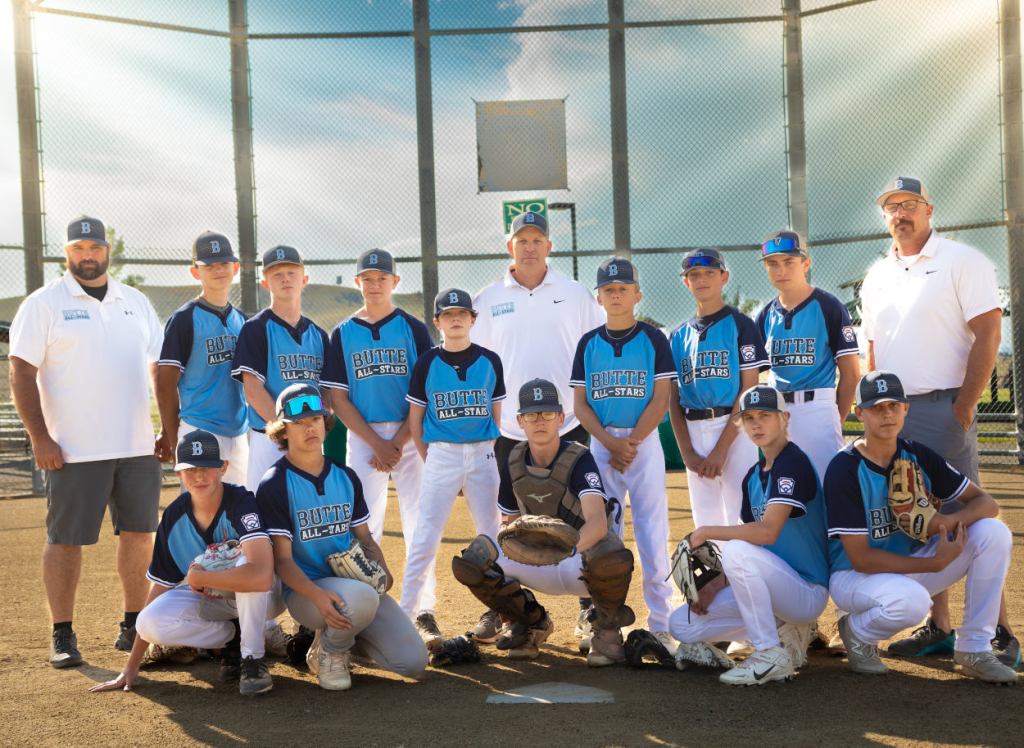
Team photo courtesy Ashley Choquette Team members are Noah Powers, Treigh Hollow, Camden Ingraham, Sawyer Casey, Calvin Cunningham, Bryson Hibbert, Koyde Kjerston, Tegan Duffy, Tucker Kissell, Miles Choquette, David Honer and Hugh O’Brien. Coaches are Mike Duffy, Chad Powers and Joe O’Brien.
Noah Powers No. 13 — Noah took the mound in 3 of 5 games in Oregon. He sturck out 19 batters in 12 innings and picked up the win against a touch Utah team. He also ripped a key RBI to put Butte up 5-4 over Arizona in the top of the 7th for the win.
Treigh Hollow No. 0 — Treigh kept an impressive .556 average at the plate while smacking 15 hits and managed to score 14 times in tournament play. He was a wall at short stop with 25 put outs and a .933 fielding percentage. Plus, he always looked cool.
Camden Ingraham No. 5 — Camden came around and really hit the ball well when needed and held a .481 on-base percentage while scoring 7 times. He gave everything he had to make sure he got a hit including an impressive Pete Rose into first.
Sawyer Casey No. 7 — Sawyer crushed line drives for Butte while holding a .409 batting average and a .500 on-base percentage with several key RBI’s. He also held a .800 fielding percentage with some great defense in the outfield.
Calvin Cunningham No. 6 — Calvin held a blistering .748 batting average with 18 RBI’s and 14 stolen bases. He had stellar pitching to get the win in the regional opener against Alaska, giving up 1 run, 7 hits with 7 strikeouts and only 2 walks.
Bryson Hibbert No. 15 — Bryson hit .409 with 7 RBI’s and a .581 on-base percentage because he sure wasn’t afraid to take a pitch off the body. A dynamic reliever on the mound, Bryson got the win with a huge save against Arizona striking out 2 in 1 1/3 innings.
Kodye Kjerston No. 2 — Kodye held a .542 batting average and a .708 slugging percentage including laying down 2 beautiful bunt singles against Utah. He got the start on the mound against a very good Arizona team holding them to 4 runs for a 5-4 victory.
Tegan Duffy No. 10 — Tegan held a .448 batting average and a .655 slugging percentage which included 7 RBI’s, 4 doubles and a triple. He crossed the plate to score 12 times for Butte and was a brick wall at catcher. He caught 50 innings and allowed only 3 passed balls while throwing out 3 base runners.
Tucker Kissell No. 3 — Tucker played some amazing defense at 2 nd base with a .950 fielding percentage and held down a .348 batting average combined with a .483 on-base percentage. He knocked in 6 RBI’s while reaching home plate 4 times for Butte.
Miles Choquette No. 8 — Miles came through with some great defensive efforts at second base. He also came up with some big hits knocking in 5 RBI’s and crossing home plate 5 times for Butte. Several of his RBI’s came at key moments.
David Honer No. 1 — David played some impressive defense in both center and left field with a 1.000 fielding percentage and held down a .333 batting average. He had some great at bats battling at the plate and drawing 8 walks.
Hugh O’Brien No. 11 — Hugh was a force to be reckoned with at the plate carrying a .588 batting average and a .720 on base percentage. He knocked in 6 RBI’s for Butte while also crossing home plate 5 times.
-
McQueen volleyball schedule

Following is the McQueen Athletic Club summer volleyball schedule for the week of Aug. 21.
Monday
Women’s
6:15 p.m. — Bumpin Ballerz vs. T and M
6:55 p.m. — Sets on the Beach vs. Setsy Time
7:35 p.m. — Hit-Faced vs. Wet Sets
8:15 p.m. — Matchblocks Twenty vs. Butte Broadcasting
8:45 p.m. — The Shitshows vs. Nothin DropsTuesday
Co-Ed
6:15 p.m. — Feck Yeah vs. Showtime
6:55 p.m. — Day Drinkers vs. Granite Mountain Electric
7:35 p.m. — Sand in Our Shorts vs. How I Set Your Mother
8:15 p.m. — Here for a Good Time vs. Parenting AssociationWednesday
Co-Ed
6:15 p.m. — Big Tippers vs. Amazingly Averagers
6:55 p.m. — Jordy & Co. vs. Sets on the Beach
7:35 p.m. — Here for Beer vs. Couple ThreatThursday
Co-Ed
6:15 p.m. — The Goon Squad vs. Just the Tip
6:55 p.m. — Crisco’s vs. Block Party
7:35 p.m. — Vu Villans vs. Can’t Get It Up -
Podcast No. 120: Brian Michelotti

Before he became the fifth executive director in the history of the Montana High School Association, Brian Michelotti was a McKinley Viking, West Junior High Buffalo, Butte High Bulldog and Carroll College Fighting Saint.
In 1990, he took home the Harry “Swede” Dahlberg Award as the outstanding boy senior athlete. That came after Michelotti, who was also an outstanding player in American Legion baseball, earned nine varsity letters competing for the Bulldogs.
He took his talents to Carroll, where he was an All-Frontier Conference defensive back for Coach Bob Petrino’s Saints.
In 2005, Michelotti began working for the MHSA. He started the organization’s website, which has been a huge asset for fans, coaches, players and media members.
On July 1, 2022, Michelotti took over as the executive director of the MHSA, replacing the retired Mark Beckman, who is also a Butte native.

In addition to running the MHSA, Michelotti is the father of six. That includes Jamey and Joey Michelotti, two former standout athletes at Helena Capital who are now members of Montana Tech’s football team.
Listen in as Michelotti talks about rooting for his sons while they play for his former arch rival. Listen as he talks about growing up in Butte and his playing days. Listen as he talks about working with the MHSA and how it proved to be a career path that was very far from what he was planning in college.
Today’s podcast is brought to you by Leskovar Honda, home of the 20-year, 200,000-mile warrantee.
 The ButteCast with Bill Foley