

Milt Popovich’s name jumped right off the program when I opened it up.
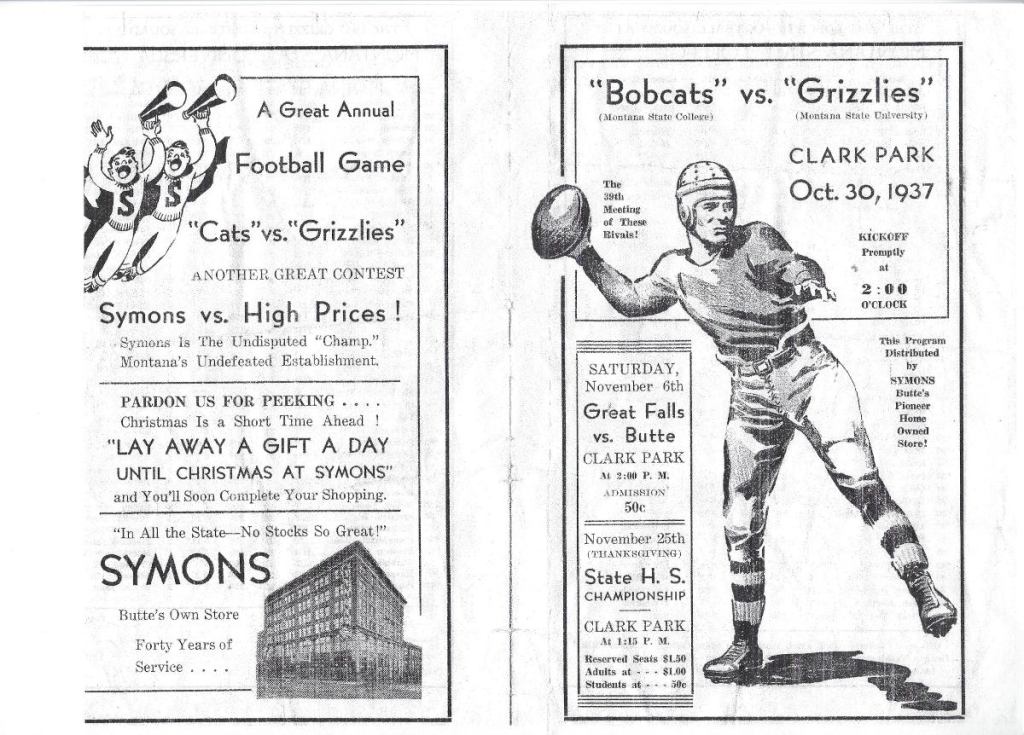
In a post-Christmas visit with my father-in-law, Pat Mulcahy, he handed me a photocopy of the game program from when the Montana State College Bobcats played the Montana State University Grizzlies at Clark Park in Butte on Oct. 30, 1937. (Go to the bottom of this column for photos of that program.)
Yes, that is what those teams were called back then.
I only got a photocopy because Pat wisely keeps the original program preserved and wrapped up in plastic.
As coincidence would have it, Pat gave me that program copy on Dec. 28. That would have been Milt’s 109th birthday.
Popovich’s name is at the very bottom of the Grizzlies roster because he wore the highest number, No. 77. He was a superstar halfback wearing an offensive lineman number.
The “Butte Bullet” went on to become an All-American with the Grizzlies, and he played five seasons in the National Football League with the Chicago Cardinals (1938 through 1942). He was a charter member of the Butte Sports Hall of Fame (1987) and the Montana Grizzly Sports Hall of Fame (1993).

Known as a humble man with a giant heart, Popovich was also a fireman for 27 years in the Mining City.
In 1937, he was one of eight players from Butte on the Bobcat and Grizzly rosters. Bobcats from Butte were Frank Strong, Bill Halloway, Nicholas Yovetich, Jack Binder and Ted Wirak. Grizzlies in the game were Harry Shaffer, Leonard Noyes and Popovich.
The “Butte Bullet,” though, stole the show, scoring the game’s only touchdown in a 19-0 Grizzly victory.
Of course, that was just one time that “Popo” terrorized his rival. According to the late Pat Kearney’s book, “The Divide War,” Popovich produced the most dominant numbers of any player in the history of the great rivalry.
Popovich accumulated 720 yards and four touchdowns in three games against the Cats. That includes 288 yards on 65 rushes. He returned two punts for touchdowns against the Bobcats in 1936 in Butte.
Milt was even a more dominant force against the rival Butte Central Maroons in his days playing for the Butte High Bulldogs.
Butte High scored a total of six touchdowns in back-to-back shutout victories over the Maroons in 1932 and 1933, and Popovich had a hand in all of them. He scored on runs of 66 and 4 yards in a 13-0 win in 1932.
On Veterans Day of 1933, BC fans were geared up to stop the “Butte Bullet.”
“I knew the Central folks thought they could stop me,” Popovich told Kearney when he was writing his book, “Butte’s Big Game,” about the Butte Central vs. Butte High football rivalry. “The Central rooters were all over me as I got off the team bus. They shouted, ‘Hey Popovich, you should just get back on the bus because the Maroons are going to beat you today. I tried not to listen to the hecklers, but they kept yelling at me. So finally, I said, ‘You watch. I’ll score a touchdown against your fabled defense today.’”

It did not take long for Popovich to back up those words. He took the opening kickoff 93 yards for a touchdown, marking the first time in the rivalry that the opening kick was returned for a score.
The only other opening kick returned for a touchdown in the rivalry came when BC’s Steve Schulte scored on an 89-yard return to start the 1978 game. Popovich’s 93-yard scamper was a rivalry record until Central quarterback Steve Markovich busted a 95-yard touchdown run in 1988.
In 1933, though, Popovich was just getting started. He followed the kickoff return by throwing a 15-yard touchdown pass to Dave O’Neill, returning an interception 48 yards for a score and punching in a 1-yard touchdown run.
The Bulldogs won 26-0.
The Montana Standard called it the “greatest one-man show in the history of the city championship series,” and you would not get an argument from any of the crowd of 5,500 at Clark Park that day.
That statement probably still rings true for the rivalry that ran through 1991. Nobody dominated like the “Butte Bullet.”
Popovich was more than just a football player. He was on Butte High’s back-to-back State championship basketball teams in 1932 and 1933, and he scored a meet-high 12 points as Butte High won the 1933 State track meet.
Football, though, was his sport. Popovich’s 102-yard kickoff return against Oregon State in 1936 set a Grizzly record. He also booted a record 67-yard punt. He led UM to a 7-1 record in 1937, when he was team captain, and he represented the Grizzlies on the at the East-West Shrine Game in 1938.
Popovich was a hero of the Greatest Generation. They talked about Popovich the way we talk about Tommy Mellott.
Sports Illustrated listed Popovich No. 23 on the list of the top 50 Montana athletes of the 20th Century, and many people in these parts thought that ranking was way too low.

I was working on The Montana Standard sports desk in June of 2005 when word broke that Popovich passed away at the age of 89.
Kearney directed me to talk to Alex Ducich and Jim Wedin, two guys who were well-known in the Butte sports scene before their passing, for a story on Popovich.
Ducich, who played in the same backfield as Popovich at Butte High, talked about how the Grizzlies should have beaten the University of Southern California in the Los Angeles Coliseum to start the 1935 season.
It would have been a monumental upset considering the Grizzlies suited up just 14 players, and USC had three full squads in uniform. The Trojans escaped with a 9-0 win.
“It should really have been 13-9 because Milt Popovich ran for two touchdowns,” Ducich, then 88, said. “Both of them were called back.”
Ducich was a student at USC at the time of the game, and he still believed Popovich’s touchdowns should have counted.
“They said he stepped out,” Ducich said, with a “no-way” tone to his voice.
Wedin was a little younger, and he remembered watching Popovich play for the Bulldogs and Grizzlies.
“I wish you could have seen him run,” Wedin told me. “He could really run. He popped those knees and boy he could cut.”
Kearney spent three years researching for The Divide War and, in 2005, he said only four Grizzly players really stand out as a “legend.”
Those are “Wild” Bill Kelly (1924-26), Popovich (1935-37), Dave Dickenson (1992-95) and Yohance Humphrey (1998-2001).
“The stories of Kelly and Popovich are still told today, while the feats of the latter two will only grow with passing years,” Kearney said.
My father-in-law knew Popovich, and he reiterated the humble-and-kind description of the Butte and Montana legend. Wedin did, too.
“He was a nice guy,” Wedin said in the days following Popovich’s death. “Everybody liked Milt.”
But it was Popovich’s prowess on the gridiron that always made the “Butte Bullet” jump right off every program his name ever appeared on. That is why Popovich’s legend still lives on today.
“All I can say is he’s the best running back in Montana that I saw,” Wedin said. “It was fun to watch him run.”
— Bill Foley, who is not fun to watch run, can be reached at foles74@gmail.com. Follow him at twitter.com/Foles74 or Bluesky at @foles74.bsky.social. Listen to him on the ButteCast on Apple Podcasts, Spotify or wherever you find your favorite podcasts.


I’m sure Pat would now include Touchdown Tommy Mellot in his list of legends!
LikeLike