
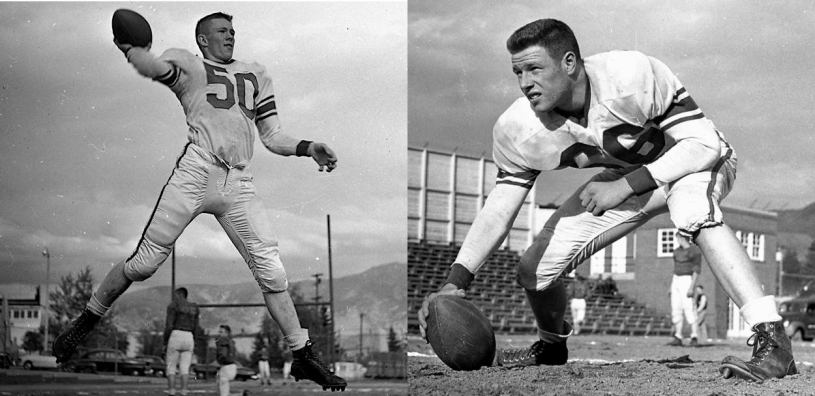
Former Bulldogs Williamson, Serigstad join exclusive company
The road to football was an unlikely one for Butte High’s two newest Diamond B’s.
Don Williamson’s father died when he was 6 months old. He was raised mostly by his grandmother while his mother worked long hours as a waitress.
Bruce Serigstad had polio as a boy, and that left him with a bum leg that kept him from reaching his full speed.
“It didn’t stop me that much,” Serigstad said, downplaying the polio battle in a phone interview from his home in San Marcos, California. “It was deformed. I was not as fast as I could have been, but I wasn’t slow either. Things worked out.”

Things also worked out for Williamson, who credits his teachers and coaches for filling in his giant parental gap.
“My whole life centered around teachers and coaches,” he said.
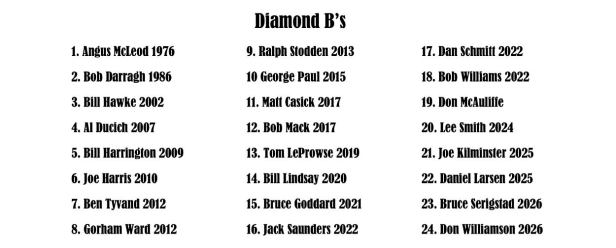
Williamson and Serigstad will officially join one of the most exclusive clubs in sports Friday night when they are inducted as Diamond B’s. Serigstad will be the 23rd member of the Diamond B’s, and Williamson will become No. 24 during the Silver B’s banquet. The event precedes Friday’s 7:30 p.m. football game between Butte High and Missoula Big Sky at Naranche Stadium.
The distinction of Diamond B comes 75 years after a Butte High football player earned his first varsity letter.
The newest Diamond B’s were standouts on some great Butte High teams coached by Harry “Swede” Dahlberg. Both lettered three times, and that includes earning a varsity letter on Butte High’s co-State championship team of 1951.
Butte High tied with Kalispell 7-all in the championship game in 1951. Neither Williamson nor Serigstad played in that championship game, but they were part of the team. They were also key contributors on the Butte High team that advanced to the Class AA State championship game in 1953.
In front of a crowd of more than 12,000 at Naranche Stadium, the Bulldogs fell 14-0 to Missoula in that title game.
After the season, Serigstad was named Class AA All-Conference by the Associated Press. That is the equivalent to a modern-day All-State selection, but only one player received the honor from each position.
Serigstad played center. At 160-pounds, he was the smallest player to receive the AP honor on the line. Like most players in those days, he played offense and defense.
Williamson played running back for the Bulldogs. He joined Serigstad and sixth Bulldog teammates in the 1954 Montana East-West Shrine Game.
Harrison Freeborn, Darrell Park, Charles Stack, Glen James, Jay Sullivan, Dick Roche also represented the Mining City in the Shrine Game that year.
At 90, Williamson still remembers his first football uniform, when he was in the fourth grade. He said he begged his Greeley School principal, Julia Shea, until she finally found something he could use.

“She went back in the closet and gave me this old, raggedy uniform,” Williamson remembered. “I took it home, and my grandmother sewed it together. I had my first football suit.”
He also had a uniform from the University of Montana. He played three years of varsity football for the Grizzlies. Williamson, a member of Butte’s 1953 American Legion state championship baseball team, also played two years of varsity baseball and ran two years of varsity track.
In Missoula, Williamson was awarded the Grizzly Cup, which was in recognition of his academic and athletics contribution to the school. Only one person received the honor each year.
The real impact of his days in Missoula, though, came from his work with the Army ROTC. In October of 1957, Williamson was one of the 10 people selected as Distinguished Military Students in the ROTC program at the Missoula school.
That led to a 35-year career in the Army. He retired as a Major General in 1993. He retired because of the Army’s 35-year mandatory retirement.
“That’s why I ended, or I’d still be there,” Williamson said on a phone call from his home in Polson. “We had a wonderful group of people all dedicated for a common cause.”
To call Williamson’s military career remarkable would be a major understatement. The former Bulldog’s career spanned through the Vietnam war and the first Gulf War.
“I was not a combat aviator, but everybody in Vietnam was in combat,” Williamson said. “Your daily activity is to survive and take care of your troops.”
He went to infantry school at Ft. Benning, Georga. He went into airborne, became an Army Ranger and a master Army aviator. He was a member of the First Calvery Division in Korea, flying planes on the Demilitarized Zone.
He was a member of the 82nd Airborne division. He served in the Pentagon for four years as a staff officer for utility and attack aircraft. He was an aviation battalion commander in Europe, and an attack Cobra helicopter manager.
Eventually, Williamson became the Commanding General of the Army Aviation Systems Command, where he was responsible for research development, production, contracting and supports.
All of that, Williamson said, was possible because of athletics, and football in particular.

“It gave me a work ethic that was phenomenal,” he said. “It helped me get through those classes and those schools. Everybody came together and they set the standard. If you’re going to play on this team, this is how they do it.
“Coaches set the standard and supported the activities that would get you to the highest standard that was achievable in those days.”
Williamson married a Butte girl, Sue Trboich, in the summer of 1958, and they have been together ever since. She handed him the phone for this interview.
“We got married one day and went to Ft. Benning the next day,” he said. “She was a trooper.”
That same summer, Williamson was selected to coach in the Shrine Game along with Mining City legend Sam Jankovich. However, the Army would not let him leave Ft. Benning for the game.
While Serigstad plays down the impact that polio and his bum leg, others clearly took notice. In 1954, the Bulldogs started their first season in four years without Williamson and Serigstad on the varsity squad.

In a story about that team, The Montana Standard called Serigstad “one of Butte’s finest inspirational players in many years.”
Like Williamson, Serigstad did not stick around the Mining City after high school.
His father, Ingolf Serigstad, was the manager of the North Butte Mining Company. With the Anaconda Co. taking over all mining operations in a post-war Butte, the Serigstad family moved to Downey, California, near Los Angeles, to open a sewing machine store.
He attended Los Angeles City College before going to Call-State Fullerton, where he played one season of football.
Eventually, Serigstad made his way to Cal Poly in San Luis Obispo.
“I was so impressed with the all the faculty and the people up in Cal Poly San Luis Obispo,” he said. “I graduated from there.”
Serigstad earned an electrical engineering degree and set out on his career path. What that path might not have garnered him the military honors of his teammate Williamson, it was still quite the prestigious career.

“I did OK,” he said, modestly. “I got into the field engineering business. I didn’t want to sit behind a desk. I wanted to be where the action was.”
That field work to him to Maine and then Arkansas, where he worked on Airforce bases. In Arkansas, he also met Nancy, his wife of 65 years.
After working with the Airforce, Serigstad eventually moved to work at a Navy base in New Hampshire.
“I went on the first submarine nuclear patrol,” he said. “Then I wound up going to Guam for three years.”
Serigstad will be able to attend Friday’s Silver B’s 87th Meeting and Induction Ceremony this Friday. Williamson was looking to see if traveling to Butte for the event would be possible, but he said it is unlikely.
Both, though, are highly impressed with the Silver B’s and the work of organization’s historian, Scott Paffhausen. Both received their Diamond B’s plaques in the mail.
“It’s amazing,” Serigstad said of the Silver B’s organization. “I’ve never heard of that at any high school having that kind of a following.’

Williamson and Serigstad are the only living members who first lettered in Butte High football in 1951. They will be representing a class that also included first-time letter winners Don Crain, Clark Doran, Don Duffy, Jim Freshman, Bud Maxson, Tom Pomroy Sr., Bill Salonen, Bill Tarrow, Al Vega, Bert West, Jerry Winkler and Bob Zorik.
All were lucky enough to play for Dahlberg, the coach who was a legend among legends.
“The kids loved him, and I did too,” Serigstad said. “He was an excellent human being and a good coach. When I look back at the people I meet, Swede Dahlberg is right there.”
Williamson credits Dahlberg, Addis McGrath, his first coach at Greeley, and a handful of other coaches and teachers for setting him on the path to his prestigious military career. They also helped turn an unlikely football player into a success story.
“The whole bunch of them, they were my father figures,” he said. “They set the standard. They set the goals. They set the standard to be on time and do your best. Without them, I wouldn’t have made it. I’d still be in Butte bartending at the … whatever.”

