
-
We need more people like Mick

It is too bad everybody couldn’t be like Mick Wonnacott.
That was something I thought about when I was lucky enough to have a class with Mick and his sidekick Josh Lovshin during my sophomore year at Butte Central.
No matter how difficult of a day you were having, there was just no way to look at Mick and not smile. The same went for Josh.
Our teacher, Tom Pendergast, labeled them Mickey-Doo and Joshy-Poo, and it just seemed so fitting that neither one argued with it. They just smiled at the monikers.
Mick and Josh were far from straight-A students. They even claimed to be the “dumb guys” in class.
They were far from dumb, however. They didn’t care a whole lot about their grades, but they were unbelievably witty and lightning quick. No matter what was said, Mick and Josh, who were a year behind me in school, had something funny to say.
The duo fed off each other, and you knew they were always there if you needed to bum a chew. Even Mr. Pendergast, a rodeoing ranch kid from Melrose, would borrow a dip from Mick and Josh during class.
No, Mr. Pendergast, who was a golf coach at BC that school year, was not a what you would call a strict teacher. He was a good teacher of history, but he certainly did not live up to the super-stringent tradition at Butte Central.
Some of the Catholic brothers would be spinning at the thought of such an easy-going teacher. That, though, is why we all loved him.

Everybody should have a teacher like Mr. Pendergast, a guy you could talk to about school, music, hunting or anything else. After giving me a ride home one night, he let me borrow his copy of Garth Brook’s cassette tape “No Fences” so I could record it.
Sometimes Mr. Pendergast would try to be serious and strict. But one look at Mick or Josh would have him busting out laughing. Mr. Pendergast could just could never play the part.
I think the class was called “life skills.” It was one of those classes that nobody took too seriously, no matter the teacher.
The days when we had to go down to the kitchen to cook were the best. It’s been 33 years, so I can’t remember what we cooked. I just remember doing a whole lot of laughing thanks to Mickey-Doo and Joshy-Poo.
I was not a big fan of school in those days. It was hard to trust other students because we were always so damn judgmental and phony.
Mick, though, never judged a soul. He was just nice guys who treated everybody well. He loved to live and laugh too much to try to make anyone else feel bad.
He was a unicorn in that regard.
If you had a chance to spend any time around Mick, then that would end up being a good day.
He wasn’t a superstar athlete or a prom king, and he certainly didn’t give a valedictorian speech at graduation. Mick was just a good guy who always made other people feel welcome.

I first met Mick at my friend Coley Crase’s house in the summer of 1988. I was about to be an eighth grader, and Mick was going into the seventh grade.
He kept talking about the fun he had at “D’Arcy’s wedding.” He was talking about my cousin Jody D’Arcy, whose outdoor wedding to Pana Mitchell on the East Ridge was the party of the summer that year.
When I told Mick that Jody was my cousin, we were instant buddies.
The D’Arcy’s and Wonnacotts were friends. When a D’Arcy ran into a Wonnacott hunting in the Highlands, it was at least an hour of daylight killed by conversation. Both sides had such a great gift for gab.
I never really had much in common with Mick. Sure, I went hunting with my cousins, but my heart was never in it. I never shot an animal. I didn’t camp, and I didn’t chew.
Mick’s conversations were often centered on hunting and camping back then. I couldn’t always relate, but he always had me laughing. Even when his jokes or lines weren’t funny — and they usually were not — he would kill me with his delivery.
Over the last three decades, I didn’t see Mick all that much. He was a labor union leader, and I avoided manual labor like the I thought people would avoid the plague.
He was sober for 22 years, and I haven’t had a sip of alcohol in more than 16. So, we weren’t bumping into each other in the bars. Instead, we saw each other when our daughters were getting prom pictures or our sons were playing sports.
Whenever I did see Mick, it was a highlight. We would always talk like old friends, and he was still always making me laugh.

The last time I saw him was at the Butte High football team’s senior banquet at the new East Middle School gym last fall. Mick was there for his step-son Torre Temple, who was one of the best defensive backs in the state as a senior last season. I was there because my son played on the junior varsity team.
Mick made a beeline toward me and told me how excited he was that I was running for chief executive of Butte-Silver Bow. He said wanted to get together to talk about how he could help my campaign, and he offered me some advice.
“Run on other people’s money,” Mick said as we made our separate ways. Those were the last words he said to me, then he slapped me on the back as he walked away.
It was like I was talking to 15-year-old Mick again. It was like we were sitting next to each other in Mr. Pendergast’s class. All these years later, and Mick never changed.
It’s really hard to type this, but Mick passed away last week at the shockingly young age of 49. We said goodbye to our old pal at his funeral yesterday, and it just seems so incredibly unfair.
All of the kids who called him dad — when Mick didn’t have to be their dad — were there. So were so many friends and a bunch of Torre’s teammates from football and basketball.
We were all heartbroken.
The title “step-dad” was so fitting for Mick. He stepped up for some boys and girls who really needed a positive male figure in their lives.
I always figured that there has to be a special place in Heaven for good step-parents. Then again, I always figured there was a special place in Heaven for a guy like Mick.
There just has to be.
For 49 years, Mick was there to make us laugh. He warmed our hearts, and he made us smile. He was responsible for a whole lot of smiles, and so many of them came when we needed them the most.
Mick lifted our spirits, even if he probably never even realized that is what he was doing. He was just being Mick, a goofy guy with a heart of gold.
Yep, the world would definitely be a better place if we had more people like Mick.
— Bill Foley can be reached at foles74@gmail.com. Follow him at twitter.com/Foles74. Listen to him on the ButteCast on Apple Podcasts, Spotify or wherever you find your favorite podcasts.
-
Leskovar Honda Athletes of the Week: Kierra Case and Adien Cuchine

Butte High senior wrestlers Kierra Case and Adien Cuchine are this week’s Leskovar Honda Athletes of the Week.
The honors come after the Bulldog grapplers had a strong weekend on the mats.
Case takes home the girls’ honor after a big-time performance to lead the Bulldogs at the Billings Mixer at Billings Senior High School. Wrestling at 138 pounds, Case went 3-0 as she continues an impressive first year competing in the sport.
“She has done great for it being her first year wrestling,” Butte High coach Geno Liva said.
Case is also a standout soccer player for the Bulldogs.

Cuchine receives the boys’ accolades after bumping up in weight and leading Butte High at the Class AA Duals in Great Falls. Cuchine moved up to 170 pounds and went 4-0 in the tournament.
“He had a great weekend,” Butte High coach Cory Johnston said.
As a linebacker, Cuchine also had a great season on the Bulldog football team in the fall.
For the second year, Leskovar Honda, home of the 20-year, 200,000-mile warranty, is teaming up with the ButteCast to honor the finest athletes from the Mining City in an effort to encourage more children to get up, get out and try all kinds of sports and activities.
Photos of Case and Cuchine courtesy Alycia Holland Photography.
-
KC basketball schedule

Following is the Knights of Columbus Athletic Club’s four-man basketball schedule for the week of Jan. 22.
Monday
7 p.m. — Cook vs. Parish
8 p.m. — Cook vs. Washington Generals
9 p.m. — Poi Time vs. Pulaski ElectricTuesday
7 p.m. — Gremlins vs. Hoopin Heathens
8 p.m. — Pulaski Electric vs. BaerWednesday
7 p.m. — Poi Time vs. Butte Sports
8 p.m. — Washington Generals vs. Alley Oopsies
9 p.m. — Parish vs. BaerThursday
7 p.m. — Butte Sports vs. Hoopin Heathens
8 p.m. — City Bois vs. Alley Oopsies
9 p.m. — City Bois vs. Gremlins
-
Podcast No. 163: Brian James Leech

When I read the book “The City That Ate Itself: Butte, Montana and Its Expanding Berkeley Pit” by Brian James Leech, I was blown away.
For one thing, I could not believe that a guy who grew up in Bozeman could so eloquently capture the heart and soul of the Mining City. He saw through the stigma that is attached to Butte to look into the eyes of the people.
Not only was he fascinated by this place, he set out for a decade-long project to explain it. Nothing can tell the story of post-World War II Butte like the story of the Berkeley Pit.
When the Anaconda Co. moved away from underground to open pit mining, it pitted Butte against itself. We needed mining to survive, but mining needed our neighborhoods.
The Berkeley Pit swallowed up the neighborhoods of Meaderville, McQueen and East Butte. Mining also relocated all the residents of the Dublin Gulch.

For years, I just assumed that the people of Butte gave into this out loyalty to the company and the good of the mining industry. That certainly was not the case.
I watched the 2023 documentary “Resurrecting Holy Savior” last spring, and that movie documents some of the fight that people put up to try to save their neighborhoods. In the fall, my good friend Michele Shea forcefully recommended that I read “The City That Ate Itself” because, as she said, it is required reading for anyone running for office in Butte.
I couldn’t put the book down. I read it in a matter of a few days, and it was eye opening.
For one thing, I want to go back in time to meet former Walkerville Mayor Jimmy Shea. The town of Walkerville should place a statue of Mayor Shea on top of the old Alice Mine Dump, which is now a beautiful site that overlooks the mining city. Without Mayor Shea, who I don’t believe is a relative of Michele, Walkerville as we know it, would not exist. He fought the vaunted Anaconda Co. and won. You cannot say that about many other people throughout history.
“The City That Ate Itself” should be required reading for anyone from Butte or Montana. It should be literally required in our high schools.

One reason I say that, is you see the same divide-and-conquer techniques used by the company during the Berkeley Pit era is still employed today. We saw that when Butte-Silver Bow and British Petroleum representatives took people on one-one-one tours through the Dublin Gulch to try to explain the killing off the old neighborhood for good — while dumping toxic waste within a chip shot of many homes — was not only a good thing, but the only choice.
We see it when they try to get by with waste-in-place cleanup in the heart of our town.
Brian Leech is a professor of history at Augustana College in Rock Island, Illinois. I caught up with him for a phone conversation, and it was a lot of fun.
Listen in to hear why Leech became intrigued with Butte at a young age. Listen to hear how he decided to write a book about Meaderville, McQueen and East Butte and all the time he spent at the Butte-Silver Bow Public Archives researching the book. Listen in to hear that Leech agrees with my assertion that we have to build a statue of Mayor Shea in Walkerville.
Copies of Leech’s book are available at the Isle of Books at 43 E. Broadway. Buy a copy and read it today.
Today’s podcast is brought to you by Casagranda’s Steakhouse. Eat where the locals eat.
-
Butte High girls’ subvarsity report

Following are the subvarsity reports, as provided by Butte High coaches, of the girls’ basketball teams games against Butte Central, Missoula Hellgate and Missoula Sentinel.
Butte High JV 60, Butte Central JV 17
Autumn Clary and Emma Johnson scored in double figures as the Maroons knocked off Butte Central Dec. 22 at the Butte Civic Center.Clary scored 10, while Johnson knocked down 10. Butte High also got eight apiece from Franki Salusso and Madisyn Swanson. Gracie Ferriter scored seven, and Addie Hiatt netted six.
Zayonna Otherbull’s 11 points paced the Maroons.
BUTTE CENTRAL — Zayonna Otherbull 11, Braelynn Schelin 2, Alex Morey 3, Rylee Forbes 1.
BUTTE HIGH — Shelbie Byrnes 4, Murphy Sullivan 2, Autumn Clary 13, Addie Hiatt 6, Franki Salusso 8, Gracie Ferriter 7, Gracie Jonart 2, Emma Johnson 10, Madisyn Swanson 8.Missoula Hellgate JV 37, Butte High JV 34
MISSOULA — Seven different Butte High players dented the score book, but the Bulldogs dropped a thriller Jan. 4 at Hellgate.
Autumn Clary’s 11 points paced Butte High in the loss. Jaycee Cleveland and Gracie Ferriter each scored six points.
BUTTE HIGH — Shelby Byrnes 3, Sidney Whitaker 4, Murphy Sullivan 2, Jaycee Cleveland 6, Autumn Clary 11, Gracie Ferriter 6, Emma Johnson.
HELLGATE — Full names for Missoula Hellgate were not provided.
Butte High Sophomores 54, Missoula Hellgate 28
MISSOULA — Allie Becker, Reese Johnson and Kendallyn Schad reached double figures scoring as the Bulldogs rolled to the Jan. 4 victory.Becker scored 17 points to lead the way. Johnson and Schad tossed in 13 apiece.
Avery Barsnes, who scored four points, took home Junkyard Dog honors for her “fantastic defense and having that true Bulldog mentality on the court.”
Kate DeShaw and Alexxys Danielson were also cited for their great defense, while Brityn Klima and Allie Ballensky were forces on the boards.
Ava Harrington’s seven points led the Knights. Presley Clark scored six.
BUTTE HIGH — Avery Barsness 4, Allie Becker 17, Reese Johnson 13, Kate DeShaw 2, Kendallyn Schad 13, Brittyn Klima 5.
HELLGATE — Qiana Palmer 2, Kaelynn Hoopfauf 5, Presley Clark 6, Lexi Cheney 4, Amalie Nevarez 2, Sidney Mardsen 2, Ava Harrington 7.
Missoula Sentinel JV 38, Butte High JV 34
Amani Yellow Owl poured in 19 points as the Spartans edged the Bulldogs Jan. 6 in Butte.Jaycee Cleveland’s eight points paced the Bulldogs. Addie Hiatt and Gracie Ferriter each scored seven for Butte. Sidney Whitaker and Franki Salusso each scored five.
SENTINEL — Full names for Missoula Sentinel were not provided.
BUTTE HIGH — Shelby Byrnes 2, Sidney Whitaker 5, Jaycee Cleveland 8, Addie Hiatt 7, Franki Salusso 5, Gracie Ferriter 7.Butte High sophomores 28, Missoula Sentinel sophomores 20
A 13-point performance from Gracie Jonart led the way as the Bulldogs downed the Spartans Jan. 6 in Butte.Butte High also got five points from Avery Barsness and four apiece from Kyra Sullivan and Alexxys Danielson.
Danielson took home the Junkyard Dog honors, while Jonart was cited with a great all-around game. Butte High’s defense held the Spartans to just five points in the second half.
SENTINEL — Full names for Missoula Sentinel were not provided.
BUTTE HIGH — Avery Barsness 5, Gracie Jonart 13, Reese Johnson 2, Kyra Sullivan 4, Alexxys Danielson 4.Butte High freshmen 44, Missoula Sentinel 33
Allie Becker scored 16 points, and Kendallyn Schad netted 12 as Butte High’s freshman picked up a “nice win” over the Spartans.
Kate DeShaw, who scored seven points, was the defensive star for the Bulldogs. Amelia Pearston scored five points, and Brittyn Klima added four.
Schad was named Junkyard Dog of the game.
SENTINEL — Full names for Missoula Sentinel were not provided.
BUTTE HIGH — Allie Becker 16, Kate DeShaw 7, Amelia Pearston 5, Kendallyn Schad 12, Brittyn Klima 4. -
Grey headed to MHSA Hall of Fame

Butte High coach Arie Grey will be part of the star-studded 2024 class of the Montana High School Association Athlete’s Hall of Fame, the MHSA announced Wednesday.
Grey earned his way into the Hall of Fame as an athlete at Powell County High School in Deer Lodge. He graduated in 1997 before heading to Montana State University to play football and run track.
Grey took over as head coach of the Butte High football program in 2008. He led the Bulldogs to the Class AA State title in 2012, and his Bulldogs finished runners up in 2019. He also coaches the boys’ and girls’ track teams at Butte High.
Grey made an appearance on the ButteCast in November of 2022. Grey is joined by six other inductees: Lindsey Hall, Tuff Harris, Richard Kronebusch, Marc Mariani, Makena Morley, and Luke Zeiger.
The MHSA Athletes’ Hall of Fame consists of two nomination categories: “Modern Era” and “Legacy Era.” The Legacy category is for nominees who have graduated at least fifty years prior to the induction year. All of this year’s inductees are from the Modern Era category, except
Richard Kronebusch who is this year’s Legacy inductee.
Following is a breakdown of each inductee, as provided by the MHSA.
Arie Grey
Powell County High School (1997)The True warrior understands and seizes that moment by giving an effort so intense and so intuitive that it could only be called one from the heart. (Pat Riley)
Arie Grey has never learned the word quit. He believes that if you are going to do something you should do it with all your heart. Throughout his life, Arie has given new meaning to the term, leave it all on the field. Whether it be on the track, court, or football field Arie Grey has always competed with intensity and grace.
Arie’s sporting career began as a Warden at Powell County High School in Deer Lodge, MT. He graduated as an 11-time letter winner. He was voted all-state in football as a junior and senior and in basketball as a senior. He was a three-time 400-meter champion in track and field. Arie went 3 years without losing a 400-meter race in Montana. His senior year, Arie swept the 100m, 200m, and 400m dash while also setting the Class B record in the 100m and 400m. After graduation, Arie was given the opportunity to play football and run track at MSU in Bozeman, MT. While there, he was voted captain of the football and track and field teams his senior year.
In 2008, Arie fulfilled his dream of giving back and becoming a head coach for the Butte High Bulldogs. He is currently the head football and track coach for Butte High School. He and his wife, Heidi (McGree), reside in Butte with their four children, Raeder, Saege, Tymber, and Aece.
Lindsey Hall
Missoula Big Sky High School (2009)Lindsey Hall began her prep career as an average freshman participant for the Big Sky track and field program, hardly garnering enough attention from her head coach to learn her name. By the time she set her blocks for her final State AA track meet in 2009, she was on her way to securing her legacy as one of the highest scoring female athletes in the history of Montana AA State track and field. In 2008, her junior year, Lindsey lead Big Sky women’s track and field to a state title, contributing 36 points. Her senior year Lindsey would eclipse that mark and score 50 points at the State AA meet, becoming the only AA female to do so. While competing for Big Sky Lindsey set four school records (100 hurdles, 300 hurdles, long jump, 4x400m), earned six individual State Championships, five runner-up finishes, and one team title. Lindsey’s competitiveness pushed her to advance her understanding of each event she competed in and often lead to long training days. Such days would remain the norm when she graduated high school and continued on as a heptathlete at the University of Montana. During her time as a Griz track and field student-athlete Lindsey won conference titles in the High Jump, Javelin, Pentathlon(3x), and Heptathlon(2x). Her 43 points at a single Big Sky championship meet are a league record, and her 205.5 career points are the most ever by a female. Lindsey represented Montana at the NCAA Championships in 2011 and 2014 in the Heptathlon, finishing 7th in 2014 to earn First Team All-American honors. Lindsey and her husband Lee live in Missoula and enjoy fishing, camping, and being on the river. She is an assistant coach with the Montana track and field program.
Tuff Harris
Colstrip High School (2002)Tuff Harris, an extraordinarily gifted athlete from St. Xavier, MT, on the Crow Indian reservation, left an incredible sports legacy as a multi-sport sensation. His high school career was nothing short of stellar, securing six state track titles across various disciplines, including the 100m, long jump, high jump, and the 400m relay. Harris broke the all-class record (10.77) in the 100M dash, becoming the “Fastest Man in Montana History”. He excelled on the football field as a wideout, running back, and return specialist. His accolades on the basketball court included many memorable high-flying dunks from his six foot athletic frame. Beyond his athletic prowess, he maintained an impeccable academic record with a 3.9 GPA, exemplifying a commitment to both sports and education.
As a walk-on for the University of Montana football team, Harris left an indelible mark on the college football landscape. He contributed significantly to the team’s success as a four-year starter and set team and Big Sky Conference records, including, most punt returns (46), most punt return yards in a season (667), most punt return yards in a game (167), and the longest punt return in both school and Big Sky history (94). His 667 punt return yards broke the NCAA record. He was named an All-American punt returner.
Tuff went on to play in the NFL with the Dolphins, Saints, Titans and the Steelers. Tuff Harris’ legacy stands as a testament to his multifaceted talents, breaking barriers and redefining records at both the collegiate and high school levels.
Richard Kronebusch
Conrad High School (1965)Being recognized as the best all-around male athlete to come out of Conrad, one would think he would have been born with football, basketball and running shoes in his crib. However, in spite of never having played organized sports before high school, Rik Kronebusch excelled in all sports offered at Conrad. He was a three-sport letterman in 1965, 66 and 67. As a Football All-Conference pick in ’66 and ’67 Rik received two KSEN Radio Golden Helmet awards and was then selected to participate in the East-West Shrine Football Game.
In basketball, Rik took third place at State during his junior year This was followed up by the team’s State Class B Basketball Championship in 1967, and Rik was a unanimous First Team All-State nod. He was the team’s leading scorer during the three year span averaging nearly 20 points and is still the all-time season and career leading scorer at Conrad.
The Cowboys fast break style of basketball transitioned into a successful track career and Rik was the 1966 and 1967 Class B High Hurdle Champion and added a title in the Low Hurdles his senior year with a state record time. In ‘66 and ’67, Rik ran a leg on the winning 880 YD relay. This performance helped Conrad collect two State B track titles. Rik completed the season with the title in the High Hurdles at the All Class “Meet of Champions” track meet and tacked on a third place in the Lows. His High Hurdle time is still the fastest recorded in Cowboy history.
After high school, Rik went on to play at the University of Nebraska Lincoln. He subsequently transferred to MSU. Even though a Spring Practice football injury ended his career, he went on to be chosen for many Independent Basketball Tourney All-Star teams. Later, he played competitive handball to wind out his sporting career on a more leisurely note. Now as a retired General Contractor, Rik and his wife Sheryl live in Helena enjoying golf and skiing.
Marc Mariani
Havre High School (2005)
Marc Mariani was a standout multi-sport athlete for the Blue Ponies and a 10 time letterman – 4 Tennis, 3 Football, and 3 Basketball. Marc was part of 4 straight divisional and state team tennis championships from 2002-2005. With doubles partner Gary Wagner, the duo placed 2nd in the state their sophomore year and were undefeated state champions as juniors and seniors. Marc was a 3-year starter at point guard on the basketball court and garnered team MVP, All-Conference, and All-State honors during his career. Mariani excelled on the football field. As a junior he earned 1st team All-State honors as both a free safety and wide receiver and was selected to the Great Falls Tribune Super State team on defense after breaking the school record with 9 interceptions and having 105 tackles. As a senior he again earned 1st team All-State honors at both positions and was named a Great Falls Tribune Super State receiver after having 48 receptions for a school record 1237 yards and 16 touchdowns. Mariani was named a captain and the MVP of the Ponies’ undefeated 2004 state championship football team. Mariani would then walk on at the University of Montana where he would break school records for catches, yards, TD’s, and all-purpose yards for the Griz. He attributes his success to his parents (Steve and Julie), his sisters (Stephanie and Katie), his many amazing high school coaches, and his classmates who were all absolute ballers and pushed each other to be the best.Makena Morley
Bigfork High School (2015)Makena’s love for running started with her mom, Jill Morley, who got the whole family into running. Morley trained with her mom before her first cross country season with Bigfork Middle School. Throughout middle school and high school, Morley trained with her two younger siblings, Logan and Bryn Morley, and father, Steve Morley. She competed in cross country and track and field all four years at Bigfork High School from 2011 to 2015.
During Morley’s time running at Bigfork High School she won 13 state titles in both track and field and cross country. In her high school track career she won 9 state titles along with earning All-American honors in 2014 for her performance in the New Balance Indoor and Outdoor national two-mile races. Cross Country was Morley’s favorite season throughout high school. She was a four-time state champion and held the Montana cross country course record. She qualified for the Footlocker National Cross Country Championships all four years of high school with three top ten finishes. [- her 3rd place finish as a senior was her highest.] Morley also represented team USA in January of 2015 during her senior year and won the Great Buppa Cross Country Championships in Scotland.
Morley started her collegiate running career at the University of Montana where she qualified for her first NCAA cross country championship in 2015. Morley then transferred to the University of Colorado where she competed from 2016-2020. At the University of Colorado, Morley qualified for the NCAA track and field and cross country championships 13 times. In 2018 she helped lead the Buffs to win the NCAA cross country championships, and had her highest cross country finish, placing 8th. The University of Colorado’s women’s team placed 3rd at the NCAA cross country meet both years prior to their win in 2018. She went on to set the University of Colorado school record in the 10,000 meters with a time of 32:28 and was in the top 6 all-time list for the indoor track 3,000 meters, indoor track 5,000 meters and outdoor track 5,000 meters. Morley graduated in 2020 during the covid pandemic, with a double major in Anthropology and English Creative Writing.
She signed a professional running contract with Asics in the summer of 2020 and continues to run professionally for Asics. She has qualified for two US olympic trials; she raced the 10,000 meters during the 2021 USA Olympic track and field trials and will race in the USA Olympic marathon trials in February of 2024. Morley won the US 25km road championships in fall of 2021, placed 2nd at the US 20km road championships in the fall of 2021, and placed 2nd overall in the US road circuit championships for 2021. She placed 10th in her debut at Chicago marathon, placing in the top 5 Americans and has gone to finish in the top 5 of many other long distance races. Along with running professionally, Morley helps out with Montana State Cross Country and Track teams and occasionally works at a local running store. She currently lives in Bozeman, MT, with her partner and fellow Montana runner, Zach Perrin, and their little dog and running buddy, Nevie.
Luke Zeiger
Glasgow School (2012)Luke Zeiger was a multi-sport star out of Glasgow, Montana. For the Scotties; he was an All-State Cross-Country runner; helping the Scottie boys to multiple State team trophies. In Track & Field, he was a 3-time state placer in the Pole Vault and was the 2012 State B Champion in the event with a winning height of 13’6”. During the summer months, he was a high-level club swimmer setting numerous Montana Federation records while earning high point honors at the State Meet in 9 out of 13 years.
His wrestling accolades at Glasgow High School are legendary. Zeiger was known for his tough competitive nature. From 2008 to 2012; Luke wrestled for the Scotties and accumulated a career record of 175-5. An incredible 97.2% winning percentage. His career mark included 93 consecutive wins from 2009 to 2011. He is one of the most dominant high school wrestlers in state history and is the only 4-time State Champion to come out of the storied wrestling program at Glasgow High School. He helped lead the Scotties to State B/C team titles in 2009 and 2010. His wrestling career was highlighted by two High School All-American finishes; including a National Championship at the 2011 NHSCA Junior National Championships in Virginia Beach. His 175 wins and 136 career pins are both ranked Top 5 in Montana High School history, regardless of classification. After high school, he competed collegiately at the University of Great Falls, North Idaho College, and Chadron State College.
He resides in Glasgow where he is a current co-owner of Ziggy’s Prime Cuts.
The MHSA Executive Board adopted a change in the way inductees are recognized for this prestigious honor. Previously the MHSA Hall of Fame Banquet was held in conjunction with the MHSA Annual Meeting. To allow for more friends and family to attend a function to honor the inductees, the Annual Meeting banquet was discontinued. Now, friends and family can organize a recognition function in the inductee’s local community at a time and place more convenient for this function to maximize attendance and support for each new inductee. Also, there is a page on the MHSA website (mhsa.org) dedicated to all of the inductees.
The physical location for the MHSA Athletes’ Hall of Fame sponsored by Wendy’s is at the Fortin Center on the campus of Rocky Mountain College in Billings. A plaque commemorating each inductee is on display on the second level in the gymnasium.
-
Podcast No. 162: Jorey Thatcher

Jorey Thatcher was brought into this world with a dangerous DNA cocktail that combines a Thatcher with a Foley. His father is Gene, one of the five Thatcher brothers known for being tough, yet kind and generous.
His mother is Kathy Foley, a recently retired, no-nonsense science teacher at East Middle School.
Jorey is just 25, yet he is already a mover and a shaker in the Mining City. In 2022, he made the 20 Under 40 list in The Montana Standard. He works as a probation officer for the Montana Department of Corrections.
He graduated from Butte High in 2017, and he played football and wrestled for the Bulldogs. Whether it was at CCCS, the Butte Detention Center or for the Department of Corrections, Jorey has worked in or with law enforcement pretty much since he graduated from high school.
He has also been a volunteer with Butte Cares, Butte DUI Task Force, the Boulevard Fire Department, East Middle School and the Special Olympics.
The special Olympics is why Jorey is on the podcast today.
He will be taking part on the Southwest Polar Plunge to benefit the Montana Special Olympics on Saturday. The Plunge will take place at 3 p.m. at Stodden Park.

Click here to donate and help the local Polar Plunge reach its goal of $15,000. You can also show up at the Plunge with a cash or check for Jorey’s team. There is no better cause than the Special Olympics.
Listen in to this podcast as Jorey talks about growing up a Thatcher and the great expectations that come with that. Listen as he talks about his years at Butte High School, some of his good friends and getting into law enforcement.
Listen as we try to figure out a way to throw his mother into the pool during the Polar Plunge.
Then go to Stodden Park on Saturday to make sure his mother didn’t kill him for our comments in this podcast.
Today’s podcast is presented by Leskovar Honda, home of the 20-year, 200,000-mile warrantee.
-
It turns out that Fraser MacDonald wasn’t a monster after all
Terror gripped my body when I was handed the slip that said I was to report to Fraser MacDonald’s office.
Fraser was the dean of boys at Butte High School, and his name was almost like a bad word. I had heard that name for years, and it was terrifying.
“Fraser gave me three nights of detention.”
“Fraser gave me five days in-school suspension.”
“Fraser won’t give me my report card until I serve all my detentions.”
My cousins, the D’Arcy boys, ran afoul of Fraser many times in their years at Butte High, and I heard about just about every time they got in trouble. Fraser, it seemed, was just some monster who could not be reasoned with.
When I transferred to Butte High from Butte Central following my sophomore year, I figured I would stay as far away from Fraser as humanly possible. Not one time was I late for school — like I was at Central all the time. Not once did I have an unexcused absence.
So, when the pink slip was handed to me by the student office aid, I thought for sure that Fraser was not going to believe that I didn’t skip. I was going to have face the unreasonable monster, and I was dead meat.
When I got to the office, Fraser was standing at the counter, dealing with a line of boys who had the same pink slip in their hand that I had.
“What, do you think you own this goddamn school?” I heard Fraser say to the first boy. “That’s five more nights.”
When the next boy handed him is form, Fraser started with, “You again, uh.” That boy’s conversation also didn’t end well. He, too, received a hefty number of nights of detention.
By the time I got to the counter, I think I was visibly shaking. I slid my pink slip to Fraser as if I was ordering from the Soup Nazi on Seinfeld.
Fraser grabbed the slip without looking at me. He held the slip with two hands for a what seemed like an eternity, and then Fraser shook his head.
“Billy,” he said as he finally made eye contact. “You didn’t skip. Get out of here.”
I had no idea how Fraser new my name. I was a golfer, and he was a golfer, but I was a Muni kid. Fraser played at the Country Club.
Fraser, though, was the executive director of the Montana State Golf Association, and he apparently paid attention to the junior and high school scores. He must have known that I was going to play golf for the Bulldogs.
Maybe he knew my grandpa Bill, who was the longtime president of the golf club at the Highland View Golf Course.
Maybe he knew my mom, who worked as a sign language interpreter at the school then.
Either way, I was thrilled that I wasn’t getting detention. I felt like I got the call from the governor at 11:59 p.m., and I was shocked that Fraser really wasn’t an unreasonable monster after all.
Well, not if you were a golfer, anyway.
My next encounter with Fraser came during the golf season. I was in the annex in a shop class when a boy I knew came in with a pink slip for me.
“I’m not even an aid,” the boy told me. “Fraser grabbed me in the hallway and told me to, ‘Get Bill Foley down here right now.’ Dude, you’re screwed.”
This time, there was no line when I got to the counter. Fraser was standing there, waiting for me.
“Billy,” he said as he waived his arm for me to walk around the counter. “Let’s go talk in my office.”
I took a seat as Fraser made a phone call to Dillon golf coach Tedd Stanisich, a Butte guy whom Fraser used to make fun of for spelling his name with an extra “D.”
A couple of days earlier, I played in the Dillon tournament with a Dillon boy who had a lot of trouble counting his shots. One of my good friends was Dillon’s best player — and one of the best players in the state. I told him that his teammate was a cheater, and he told Stanisich.
For about 10 minutes, I sat there and talked on the phone with Fraser and Stanny as they gave each other their typical hard time over the phone.
Stanny also asked me a couple of questions about his cheater. I didn’t want to be a narc, but Stanny already suspected the boy couldn’t count.
I was able to be a part of similar conversation a couple of times years later when I was covering MSGA tournaments for the newspaper. Fraser would always joke about Stanny being a sandbagger, an accusation Stanny laughed about, but denied.
Fraser, who passed away at the age of 88 on Jan. 6, was inducted into the Butte Sports Hall of Fame in 2017. That happened to be the first year that I was the executive director of the Hall of Fame.
It seemed so fitting that the Hall of Famers voted in Fraser as a contributor because he was a member of the selection committee that picked the first class of the Hall of Fame in 1987.
When Ron Davis asked Fraser if he was surprised to be selected during the induction ceremony, Fraser said, “Well, I know this. I wasn’t in the company of the people who went in the first time.”
Among the many contributions he made to the local sports scene, Fraser was a radio announcer. He called Butte High and Montana Tech games. He also called Butte Copper Kings baseball games.
When he first started working at KBOW, a young Paul Panisko was running the board for Fraser as he called a football game. As the clock ran out for halftime, Paul had two minutes of commercials queued up for the break, assuming Fraser would talk about the game at the half.
Instead, Paul got a lesson in scrambling to fill dead air as he heard Fraser say, “We’ll be back after this 20-minute break.”
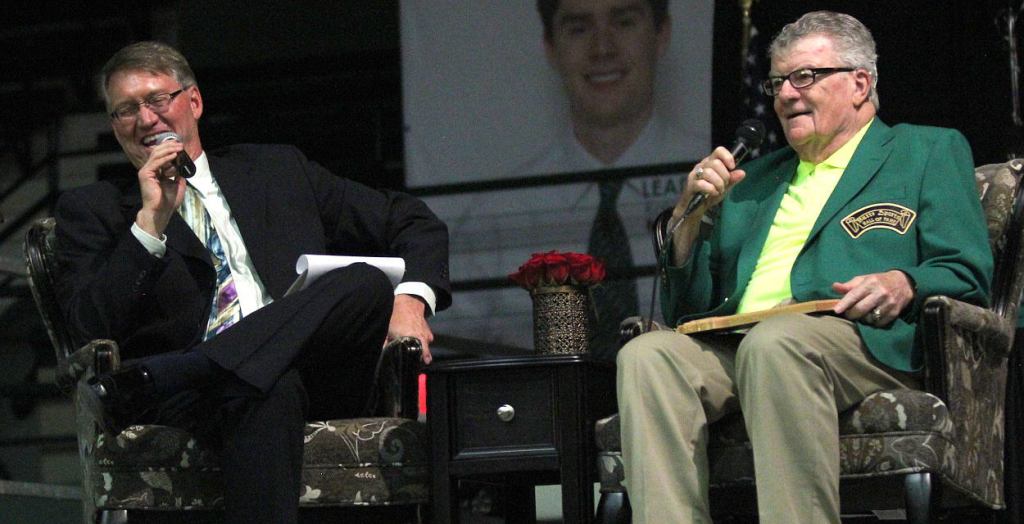
Ron Davis, left, cracks up at a remark by Fraser MacDonald during the 2017 Butte Sports Hall of Fame induction ceremony at the Butte Civic Center. Davis, a broadcasting legend himself, says that Fraser is the one who taught him how to call a game.
I got to talk to Fraser a ton during the months leading up to his Hall of Fame induction. He was so excited to join the list of Butte legends, even if he would joke that he didn’t belong.
Even after the induction, Fraser would occasionally give me a call out of the blue for the next couple of years. I would often have tears of laughter running down my face by the time I hung up.
It has been several years since Fraser made me laugh. I tried to call him a few times to try to correct his address so I could make sure he got a ballot to vote for Hall of Fame classes, but he never answered.
I knew his hearing was bad, and I knew he was dealing with dementia. Still, I was hoping for one more time to see Frasier, who most definitely belongs with the other immortals who donned the Green Jackets of the Butte Sports Hall of Fame.
That hope faded away for good when I saw his obituary online. Fraser was 88, but it still seems too early to say goodbye.
When I look back at Fraser’s life, though, I will do so with a smile. I might even laugh out loud some times.
It is amazing to think that to me, he went from an unreasonable monster to a legend to a friend.
I will miss him.
— Bill Foley, who is kicking himself for not skipping after getting the golf pass from Fraser, can be reached at foles74@gmail.com. Follow him at twitter.com/Foles74. Listen to him on the ButteCast on Apple Podcasts, Spotify or wherever you find your favorite podcasts.
-
Stajcar, Graham win District Shoot

DILLON — Butte’s Oakley Stajcar and Ellison Graham won their respective age groups at the Montana South District Elks Hoop Shoot Saturday at Montana Western’s Straugh Gymnasium.
Both young Butte athletes will advance to the Montana State Hoop Shoot, which is Feb. 3 in Livingston. The South District is made up of Butte, Anaconda, Deer Lodge, Dillon and Helena, and only the champions in each age group move on.
Stajcar, a third grader at Butte Central, made 17 out of 25 shots to win the girls’ 8-9 age group title. Charley Parsons of Boulder placed second with 12 makes.
Graham, a seventh grader at East Middle School, hit on 22 of 25 shot to win the girls’ 12-13 group. Dillon’s Adry Gibson took second with 17, and Brigid Mehrens of Anaconda placed third at 15.
Graham, who moved to Butte before the 2022-23 school year, won the national championship in Chicago in 2021. She placed fourth in 2022.
Kansas Keller of Dillon won the girls’ 10-11 age group. She made 18 shots and then edged Butte’s Tenley Osborne in triple overtime for the victory.
Anaconda’s Tre Estes and Luke Baker and Dillon’s Noah Feenstra won boys’ titles.
Estes hit 21 shots to win the boys’ 8-9 age group. Butte’s Hunter Boyle took second at 17, one shot better than Dillon’s Kenny Holland.
Baker won the boys’ 10-11 group with 17 shots. Dillon’s Austin Blando and Butte’s Bentley DeTonancour were next at 15. Blando took second with an overtime victory.
Feenstra sank 22 shots for the boys’ 12-13 title. That was one shot better than Butte’s Miles Choquette.
At the state meet, the six South District champions will compete against the champs from the other districts. The state champions will advance to the Regional shoot, which is March 9 in Rapid City, South Dakota.
The National Finals will be held April 20 in Chicago. The names of all the national winners will have their names digitally displayed in the Naismith Basketball Hall of Fame.
The Elks Hoop Shoot is sponsored by the Benevolent and Protective Order of Elks of the U.S.A. It is endorsed by hundreds of school systems around the country. The Elks fund the program primarily through its National Foundation and the support of the local lodges and state associations.
The Elks Hoop Shoot began as a local program by Corvallis, Oregon Elks in 1946. It is in its 52nd year of national competition. More than 3 million boys and girls are expected to participate this year.
Click the link below to see the results from the South Regional Shoot.
-
Leskovar Honda Athletes of the Week: Kenzie McQueary and Ryan Peoples

Butte Central basketball players Kenzie McQueary and Ryan Peoples are this week’s Leskovar Honda Athletes of the Week.
McQueary, an eighth grader, takes home the girls’ honor. She hit a huge 3-pointer with less than a minute left as the Maroons beat Stevensville 34-29 Jan. 6 in Stevensville. She scored seven points in the victory.
“She’s a great kid,” BC coach Quinn Carter said. “She’s got a good future ahead.”
Even though she does not yet attend the high school, McQueary is ranked third on the BC team in scoring.
Peoples, a sophomore, takes home the boys’ award after scoring 19 points to lead the Maroons to a 67-43 win at Frenchtown. Peoples hit 5 of 7 shots from behind the 3-point line in the victory.
Since Christmas, Peoples is averaging 15 points while shooting 58 percent from 3-point land. Through 10 games, Peoples has connected on 21 of 49 shots from downtown.
For the second year, Leskovar Honda, home of the 20-year, 200,000-mile warranty, is teaming up with the ButteCast to honor the finest athletes from the Mining City in an effort to encourage more children to get up, get out and try all kinds of sports and activities.
Photo of McQueary provided by Jacqueline Photography. Photo of Peoples courtesy BnO Photography.
 The ButteCast with Bill Foley