
-
Sottosanti, Tico win doubles handball

BOZEMAN — The duo of Sam Sottosanti of Butte and Chris Tico of Sandpoint, Idaho teamed to win the Montana State Doubles Handball Championship Sunday at the Ridge Athletic Club.
Sottosanti and Tico defeated the Billings team of Justin Balkenbush and Spencer Larsen 16-21, 21-12, 11-5 in a match that took nearly two hours. Balkenbush and Larsen were the defending champions. It is Sottosanti and Tico’s first Montana State championship.
Mike Meyer of Billings teamed with Rick Harrington of Missoula to claim both the Diamond Masters (70-plus) and Super Golden Masters (60-plus) titles. They defeated Tom Morris and Dan Scilley in the Diamond Masters and Jeff Armstrong and Dan Adams in the Super Golden Masters.

Butte’s Brett Badovinac and Don Foley defeated the Bozeman team of Mark Morrill and Frank Cikan to win the Golden Masters (50-plus).
The Bozeman team of Evin Groves and Todd Williamson defeated Daniel Dice of Bozeman and Marcus Madrazo of Butte to win the A Division.
Complete Results:
Open
First Round – Chris Graham and Clyde Barton, Billings d. Mark Morrill and Frank Cikan, Bozeman 21-19, 18-21, 11-8
Quarterfinals – Justin Balkenbush and Spencer Larsen, Billings d. Daniel Dice, Bozeman and Marcus Madrazo, Butte 21-6, 21-6; Austin Meyers, Bozeman and Les Seago, Emigrant d. Jay Stender and TJ Stender, Sheridan, WY by injury default; Brett Badovinac and Don Foley, Butte d. Evin Groves and Todd Williamson, Bozeman 12-21, 21-13, 11-9; Sam Sottosanti, Butte and Chris Tico, Sandpoint, ID d. Graham and Barton 21-2, 21-2
Semifinals – Balkenbush and Larsen d. Meyers and Seago 21-12, 21-2; Sottosanti and Tico d. Badovinac and Foley 21-8, 21-9
Finals – Sottosanti and Tico d. Balkenbush and Larsen 16-21, 21-12, 11-5Diamond Masters (70+)
Round Robin
1st – Rick Harrington, Missoula and Mike Meyer, Billings d. Dan Scilley, Luther and Tom Morris, Billings 21-8, 21-10; d. Sandy Gagnon and Jon Ford, Bozeman 21-12, 21-2
2nd – Scilley and Morris d. Gagnon and Ford 21-10, 21-12Super Golden Master (60+)
Round Robin
1st – Mike Meyer, Billings and Rick Harrington, Missoula d. Jeff Armstrong, Billings and Dan Adams, Helena 21-14, 13-21, 11-6; d. Dan Bersanti and Tom Madrazo, Butte 21-8, 21-14
2nd – Armstrong and Adams d. Bersanti and Madrazo 21-9, 21-3Golden Masters (50+)
Final – Brett Badovinac and Don Foley, Butte d. Mark Morrill and Frank Cikan 21-12, 21-17A Division
Semifinal – Marcus Madrazo, Butte and Danial Dice, Bozeman d. Mark Morrill and Frank Cikan, Bozeman 21-16, 21-12; Evin Groves and Todd Williamson, Bozeman d. Chris Graham and Clyde Barton, Billings 21-3, 21-6
Final – Groves and Williamson d. Madrazo and Dice 21-20, 21-3 -
KC basketball schedule

Following is the Knights of Columbus Athletic Club’s four-man basketball schedule for the week of Jan. 15.
Monday
7 p.m. — Poi Time vs. Cook
8 p.m. — Cook vs. Alley Oopsies
9 p.m. — Washington Generals vs. ParishTuesday
7 p.m. — City Bois vs. Jellyfam
8 p.m. — City Bois vs. Baer
9 p.m. — Baer vs. Hoopin HeathensWednesday
7 p.m. — Gremlins vs. Jellyfam
8 p.m. — Pulaski Electric vs. ButteSports
9 p.m. — Washington Generals vs. Poi TimeThursday
7 p.m. — Alley Oopsies vs. ButteSports
8 p.m. — Pulaski Electric vs. Gremlins
9 p.m. — Parish vs. Hoopin Heathens
-
No. 161: Christine (McGuinn) Nehls

This is probably most difficult subject tackled on the ButteCast. It might also be the most important.
Christine (McGuinn) Nehls reached out to me because she wanted to talk about suicide. Her husband, Aaron, passed away as the result of suicide on Feb. 24, 2009. He left behind Chris and her two daughters.
Chris wanted to do this podcast for a couple of reasons. No. 1 is she hopes it encourages other people to reach out for help — either for themselves or someone they know. Depression is a disease, and it can claim lives just like cancer. Depression, though, is beatable if you get the help.
Call the Suicide and Crisis Lifeline at 988 if you find yourself in a dire situation. You can also call a friend or talk to a family member.
The second thing Chris wanted to accomplish with this podcast was to have Aaron remembered for how he lived instead of how he died. She said he was just the nicest guy in the world. She met Aaron when she was 15.

The two were accidentally paired together to ride the Zipper at the carnival in the back parking of the Butte Plaza Mall. Chris was a “jock.” After all, her step-dad was the late, great Jim Hanley, a Butte Sports Hall of Famer. Aron was a “head.” He had long hair and he played the drums.
But the opposites attracted, and Chris and Aaron married when they were 21 years old. Aaron was a loving father and husband. He was a talented musician in rock bands, and everyone seemed to like him. He loved to fish and he loved to hunt. That, though, was not enough for him to overcome his depression.
Listen in to this podcast as Chris talks about Arron, his life, his death and how people looked at her differently after his passing. Listen to hear how the suicide impacted the lives of Chris and Aaron’s daughters.
Listen to hear that Aaron showed signs of suicide, and how that might help you identify if a loved one is contemplating taking his or her own life.
If you take anything out of this podcast, it should be that it is OK to reach out for help. Even the toughest of people can feel sad, and Chris does not want you to go through what she has had to endure these last 15 years.
Chris did not want this podcast to be about her. That is why the photo above is of Aaron.
Today’s podcast is brought to you by Thriftway Super Stops. Download the TLC app today and start saving.
-
No. 160: Butte Sports Hall of Fame

We held the Butte Sports Hall of Fame public forum Tuesday night at the McQueen Club.
It was a great night. Some 20 speakers make their case for a nominee in front of the selection committee.
We heard from Bill Melvin, Terry Lonner, Tom Peterson, Tim Norbeck, Chris Tippett, John Thatcher, Jarred Nadeau, Pat Ryan, Bob Rowling, Mudge Tamietti, Tracy Holmes, Robert Lester, Danny Kaluza, Bernie Boyle, Mike McGree, Fran Doran, Ray Matteson, Logan Parvinen, Bob Green and Franklin Schwartz, in that order.
More people have sent short videos to test for a candidate. If you would like to send a video or letter of recommendation, you still have time. We will accept them until Jan. 20.
Email them to foles74@gmail.com or text to (406) 491-3022.
In the meantime, consider this podcast a lecture in Butte Sports history. The volume might go up and down depending on the speaker.
Today’s podcast is presented by Casagranda’s Steakhouse. Eat where the locals eat.

-
First interview with Chuck Morrell was no easy task

It was by far the hardest we ever worked on an interview.
Paul Panisko and I were joined by brand-new Montana Tech football coach Chuck Morrell on our old sports radio show KBOW Overtime shortly after he arrived in town to take his new job. I believe it was in January of 2011.
Now, most people were not going to stack up in comparison to the recently-retired Tech football coach. When it comes to giving interviews, nobody can beat Bob Green.
The shoes to fill were bigger than the ones worn by Shaquille O’Neal.
So, the bar of expectations was set pretty low as we introduced the new coach to the Mining City. Paul and I quickly realized that we set it too high.
The show was broadcast live from the Coaches Corner inside the Metals Sports Bar & Grill. It was a show that was very informal, and we always just asked questions off the top of our heads.
I don’t remember one time in 15 years of the show that we ever wrote down a question ahead of time. That night, though, we should have.
We did our homework for this interview, though. But it didn’t help.
Paul would dress up a question to Coach Morrell, and he would answer with one word. Then I would ask a question. Again, a one-word answer.
For a half an hour, Paul and I peppered the coach with questions about taking over the job, what he was looking forward to, the recruiting season, the history of Tech, his past as a player and a coach and replacing a legend like Green.

Sometimes we got a full sentence answer from a question. Most of the time, though, it was one- or two-word answers.
That half an hour felt like seven days.
Morrell was clearly a no-nonsense guy, and he did not know us at the time. He had no reason to trust that we were not the kind of guys who would try to get him with a “gotcha” question.
Interviewing him that night was only rivaled in difficulty by the time I interviewed swimming superstar Erin Popovich, when she was in middle school. The super-shy Popovich just kept shrugging her shoulders when I asked questions, but at least it wasn’t a radio interview.
I was thinking about that interview with Morrell as I watched him call the defensive plays for Washington in the National Championship football game Monday night.
The guy came to Butte guarded as can be, and he left, well, as a Butte guy. He says he plans to move back to the Mining City when he retires from coaching.
By the time he left to join his best pal Kalen DeBoer as an assistant at Fresno State in December of 2019, Morrell was one of the easiest interviews. He wasn’t on the level of Green, who used to wait until your pen stopped moving to go on to the next sentence, but he was always a lot of fun to talk to.
In my 25 years or so working as a sportswriter, Morrell has to rank among the very best coaches to interview. He easily ranks among my favorite coaches.
He was always honest and upfront. He never sugarcoated anything, and he never asked me to sugarcoat anything for him.
Dealing with a coach as a sportswriter is always interesting because no two coaches are alike.
I never got to interview Montana Grizzlies legend Don Read, who passed away last week, but I met him once in 1995. Nearly two years later, Coach Read was back in town to announce a Grizzly game on television. I was at a practice waiting to talk to Coach Mick Dennehy, and Read was at that practice.
Coach Read was walking off the field and looked my way. From about 25 yards away, he recognized me, said my name and walked over to shake my hand.
Read remembered every name. He could have been a politician.

I succeeded Tom Mullen was the sports editor of The Montana Kaimin, the University of Montana student newspaper. Tom was lucky enough to interview Coach Read, who used to take his phone off the hook and shut his office door for interviews.
Dennehy could not have been a politician, and he certainly never took his phone off the hook. He didn’t like interviews with anyone, but he was always good to me for one reason.
We were both Butte guys.
Amazingly, Mick was not the toughest interview at the University of Montana. That distinction went to volleyball coach Dick Scott. I felt like I was talking to an angry Mike Ditka after matches the Grizzlies didn’t win.
I was able to build a great relationship with Coach Scott, though, and working with him prepared me for interviews with John Thatcher when he coached the Butte High boys’ basketball team.
Thatcher is the only coach to threaten to beat me up in an interview. I’d like to think he was joking, but I’m not entirely sure.
The most brutally honest coach I ever dealt with was Meg Murphy, who is also one of the greatest coaches I ever got to interview. Whether she was talking about a poor performance from a player, an official or even herself, Meg never held back.

Marilyn Tobin was also brutally honest as the volleyball coach at Montana Tech. One time I asked her if there were any positives that she could take out of a home conference loss.
“Yes,” Coach Tobin said after giving me a look to tell me I asked a stupid question. “I didn’t shoot any of them.”
Arie Grey, Butte High’s football coach, doesn’t fall into the “open-and-honest” category like Murphy and Tobin. He talks to me in coach speak every time I talk to him.
I could say something like, “Beautiful day, isn’t it?” Arie would respond, “We’re on to Cincinnati.”
He smiles more than Bill Belichick, but he doesn’t always say much more.
Of course, there is nobody I want my son to play for more than Coach Grey, a guy who truly gets the reason he is coaching high school football.
I could say the same about Don Peoples Jr. The Butte Central coach, though, is a million times more open than Coach Grey.
Some coaches need to be recorded because the talk so fast, especially after a game. Current Montana Tech football coach Kyle Samson definitely falls into that category.
Coach Samson’s father, Mark, was the exact opposite. I never used a recorder when talking to Mark Samson, whether he was coaching high school or in college.
Most of the time after a game, a writer is looking for a minute and a half — 2 minutes, tops — from a coach. Mark Samson was always at least a half hour interview.
In all the years working as a sportswriter, though, no coach ever changed as much as Morrell. He certainly did not trust me or Panisko that first night on Overtime.
By the time the Orediggers won his first game — on a double-overtime walk-off touchdown run by the great Pat Hansen — Morrell was pretty warm to us.
By the time his Orediggers knocked off Carroll College later that season, Morrell was the best interview in town.
I can’t wait to have him as a guest on my podcast when he comes back to Butte this summer.
Even though the championship game didn’t work out the way we wanted, it will be fun to hear Coach Morrell’s take on the great season by his Washington Huskies.
There will not be many one-word answers this time around.
— Bill Foley, who is on to Cincinnati, can be reached at foles74@gmail.com. Follow him at twitter.com/Foles74. Listen to him on the ButteCast on Apple Podcasts, Spotify or wherever you find your favorite podcasts.
-
Will Silk wins junior national title

KERNS, Utah — Butte’s Will Silk won the US Junior Speed Skating Championships Saturday at the Olympic Oval.
Silk is a senior at Butte High School. He skated personal best times in all four races and narrowly edged Dylan Woodbury of Salt Lake City.
Silk won the 1,500-meter and 5,000-meter races with times of 1 minute, 50.32 seconds and 6:43.65. He finished fourth in the 500 meters in 38.11 and fifth in the 1,000 meters in 1:13.46.

He edged Woodbury, who won the 500 and 1,000 by 0.016 Samalog points, which are calculated by dividing the skaters time in each race by the number of 500 meters in the event.
By placing in the top three, Silk earned a spot on the US team for the Junior World Speed Skating Championships in Hachinohe, Japan Feb. 9-11. He skated in two Junior World Cup races in Italy in November and December.
Click the link below for complete results. A summary of the Junior Men’s results on page 47 at the end of the document.
-
Leskovar Honda Athletes of the Week: Sophie Grunhuvd and Josh Sutton

Butte High’s Sophie Grunhuvd and Butte Central’s Josh Sutton are this week’s Leskovar Honda Athletes of the Week.
The honors come after a big opening week of 2024 by the two student-athletes who are off to strong seasons for the Bulldogs and Maroons.
Grunhuvd, a sophomore, receives the girls’ honor two days after winning the 126-pound girls’ division at the Tom LeProwse Invitational in Bozeman. Grunhuvd went 5-0 to win the tournament named in honor of the Butte legend. All five of her wins came by way of the pin, including three in the first minute of the match.
Grunhuvd pinned Karissa Afrank of Baker in 5 minutes, 43 seconds in the championship match. Grunhuvd placed second at 120 points at the State tournament last February.

Sutton, a freshman, scored a total of 30 points in two varsity games as the Butte Central boys’ basketball team won at Anaconda and at home against Stevensville. He shot 80 percent, grabbed eight rebounds and dished out three assists in the two games.
Sutton, who contributed to BC’s varsity team as an eighth grader last season, scored 16 points as the Maroons beat Anaconda 56-28 at the Snake Pit. He tossed in 14 as BC routed Stevensville 79-14 at the MAC. He is averaging 11.9 points per game this season.
For the second year, Leskovar Honda, home of the 20-year, 200,000-mile warranty, is teaming up with the ButteCast to honor the finest athletes from the Mining City in an effort to encourage more children to get up, get out and try all kinds of sports and activities.
Photo of Grunhuvd courtesy Alycia Holland Photography.
-
KC basketball schedule
Following is the Knights of Columbus Athletic Club’s four-man basketball schedule for the week of Jan. 8. There will be no games played on Monday because of the national championship football game between Michigan and Washington.
Monday
No gamesTuesday
7 p.m. — Poi Time vs. Baer
8 p.m. — Pulaski Electric vs. Alley OopsiesWednesday
7 p.m. — Baer vs. ButteSports
8 p.m. — Jellyfam vs. Cook
9 p.m. — Washington Generals vs. GremlinsThursday
7 p.m. — Hoopin Heathens vs. Gremlins
8 p.m. — Parish vs. City Bois -
Hall of Fame public forum is Tuesday
The public forum for the Butte Sports Hall of Fame will be held Tuesday at 8 p.m. at the McQueen Club.
The forum was moved back one day because of the Michigan-Washington FBS national championship game. The move also allows Montana Grizzly fans attending the FCS national championship game in Frisco, Texas a better chance to attend the forum.
People will be asked to keep their comments to 3 minutes as they speak on behalf of candidates before the Butte Sports Hall of Fame selection committee.
Selection committee members are Jim Street, Anna Keltner, Mike Hogart, Jason Alexander, Phil Madrazo, Dave Dunmire, Michele Shea, Gina Evans, Cathy Tutty, Ray Jay Johnson, Matt Vincent and Krystin Mengon Lee.
People can only speak on behalf of candidates nominated by the Dec. 31 deadline. Late nominations will not be accepted. Those who cannot attend the meeting can send short videos to Bill Foley, Butte Sports Hall of Fame executive director, at (406) 491-3022 or foles74@gmail.com.
Men nominated and eligible for public forum speakers are: Colt Anderson, Mike Anderson, Terry Barkell, Tom Berg, Bobby Bentley, Matt Buckley,Brian Bolton, Pat Bolton, John Connole,Bernie Brophy, Mike Carle, Jim Coyne, Matthew Crowe, Rick Dessing, Neil Egan, Jay Fagan, Scott Ferguson, Jim George, John Gibson, Jamie Harris, James “J.W.” Hodges;
Jim Hope, Ryan Hitchcock, Rich Hollis, Pete Hristou, Rob Johnson, Andrew Kalarchik, Henry Klobucar, John Kovacich, Jake Larson, Dan Lean, Chad Lembke, Jay LeProwse, Paul LeProwse, Mike Lyons, Joe McClafferty, Dan McGree, Marc McGree, Tom McIntyre, Marc Murphy, Rick Nadeau, John O’Neill, Todd Paffhausen, Kevin Parvinen;
Rich Paull, Matt Pelletier, Don Peoples Jr., Charlie Peterson, Mark Peterson, Gene Popovich, Pat Prendergast, Chris Rasmussen, Tom Reopelle, John Ries, Ted Richards, John Rickman, Greg Salo, Kelvin Sampson, Steve Schulte, Curtis Smith, Kyle Smith, Jon Smitham, Rob Spear, Steve Stanisich, Mark Struznik, John Sullivan, Don Tamietti, Justin Thatcher, Bryl Thompson, Mike Thompson, Si Timberman, Craig Tippett, Jay Vogelsang, Sean Walsh, Bryon Wilson and Ernie Wilson.
Women nominated and eligible for public forum speakers are: Jodi (Hogart) Blixt, Kristen (Tuttle) Chambers, Barbara Cockhill, Michelle Durkin, Gayle (Clark) Holm, Jeni Hope
Jami (Hope) Humphrey, Lori (Bruin) Jurenic, Alicia (Wheeler) Kachmarik, Susan Kaluza
Kelley Kingston, Karin (Jolley) Kuszmaul, Christin (May) Lacombe, Martha (Apostel) Lonner, Fawn Lyons, Linda Lyons-Paull, Lori Markovich, Michelle (Bisch) Mattson, Wanda (Matteson) Olson, Dawn (Nadeau) Petritz, Erin Popovoch, Jamie (Hardesty) Reopelle, Melissa (Ritter) Swanson, Chris Cuchine Vidrich, Leena Worrell and Mary Yakawich.Candidates in the veteran and contributor categories will be voted on by members of the Butte Sports Hall of Fame. The ballots were sent out this week and are due back by Jan. 29. Any Hall of Famers who do not receive a ballot should contact Foley.
-
Podcast No. 159: Jim Michelotti

Not many people have done more to preserve history in the Mining City than Jim Michelotti.
Before Jim and his wife Margie raised four sons who were all successful athletes, Jim grew up in the McQueen neighborhood.
He knows all about experiencing life in McQueen and Meaderville before the Berkeley Pit swallowed those neighborhoods.
Jim has been interviewed countless times for news stories, books and movies. He played a prominent role in the documentary “Resurrecting Holy Savior,” which came out in 2023. Jim volunteers a ton of time to the Butte-Silver Bow Public Archives, and he even joined the group of former Dublin Gulch residents recently to try to save that old neighborhood from British Petroleum and Butte-Silver Bow’s plans to cover it with toxic waste.
Jim is pushing for an interpretive museum in the old Dublin Gulch to honor the men and women from the old neighborhoods of yesterday — McQueen, East Butte and Meaderville. It should really be something.
Jim was also a key contributor to the sporting scene in Butte. He was inducted into the Butte Sports Hall of Fame in 2013 for his work as a contributor, including the countless hours he spent helping Bernie Boyle turn the Knights of Columbus into a sports museum.
After Pat Kearney passed away suddenly in 2014, Jim was one of a handful of individuals who make sure the Butte Sports Hall of Fame survived.
Listen in to this podcast to hear Jim reminisce about growing up in McQueen and the work he has done to preserve the memories of the neighborhood. Listen in as he talks about raising four boys and to hear what it was like when he had one boy on each side of the Montana Tech-Carroll College rivalry.
Today’s podcast is brought to you by Leskovar Honda, home of the 20-year, 200,000-mile warrantee.
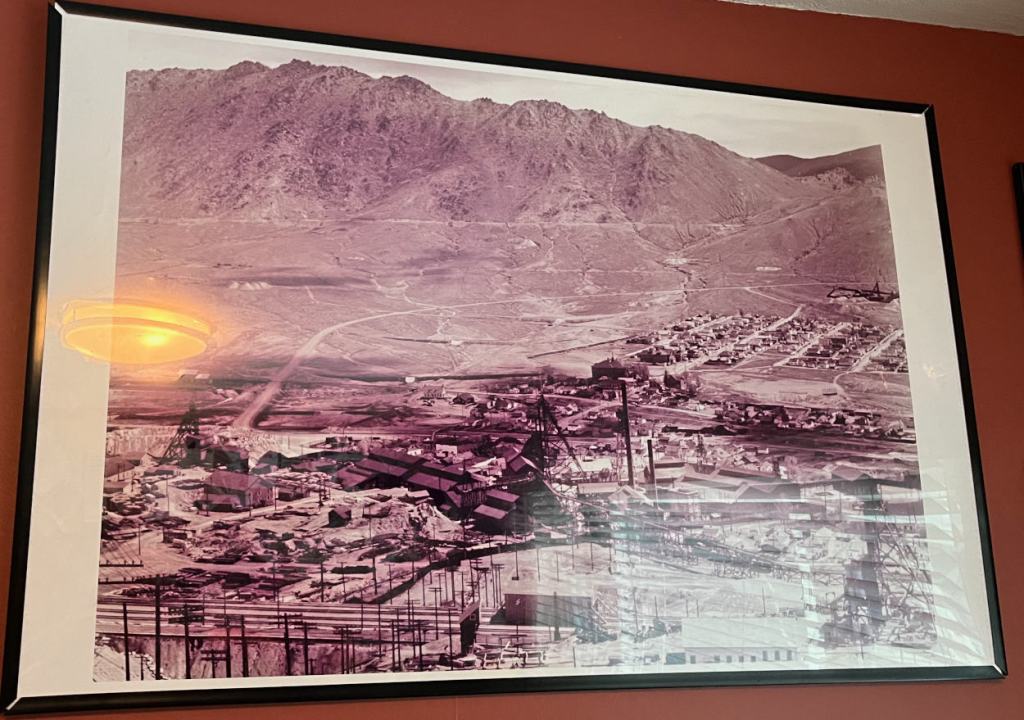
This is the photo on of McQueen and Meaderville on Jim Michelotti’s wall. It was referenced many times during the podcast.
 The ButteCast with Bill Foley